🎯 Key Takeaway
- Asking how many Google reviews do I need has no fixed answer, because the number depends on how many you already hold
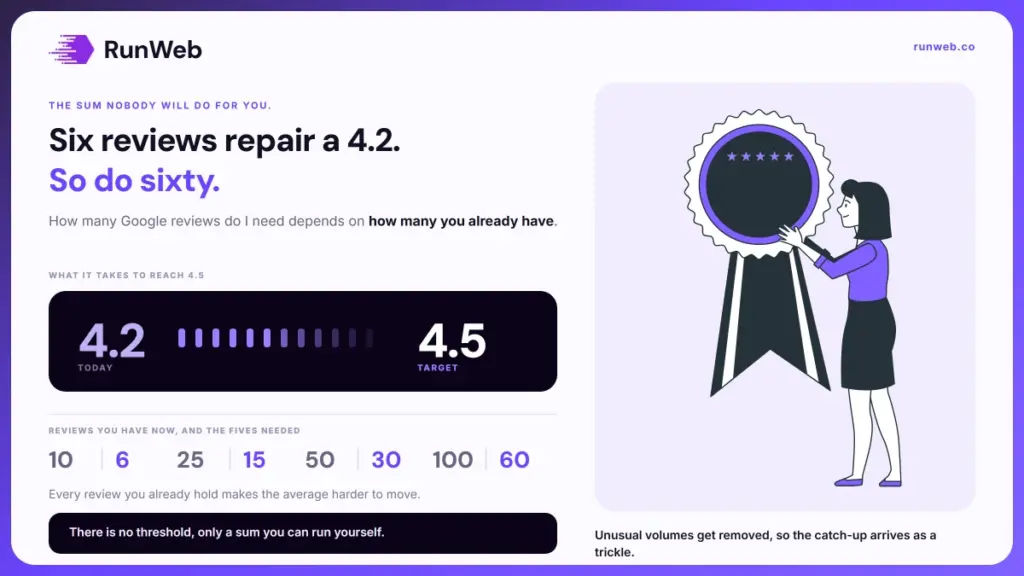
- Lifting a 4.2 to a 4.5 takes six new five-star reviews at ten, and sixty at a hundred
- Your first ten reviews swing the average hardest, in both directions
- Google says more reviews and positive ratings can help local ranking, and that ranking cannot be bought
- Unusual volumes get removed, so the catch-up has to arrive as a trickle
There is no number, and there is a sum.
Every guide answers this question with a consumer survey. Those surveys report what shoppers say in the abstract, and they say nothing at all about your own listing. The arithmetic behind a star average is fixed, and it produces a different answer for every business that asks.
Two firms can sit at the same 4.2 and need wildly different amounts of work to reach a 4.5. One needs six reviews. The other needs sixty, and the only thing separating them is history.
So the question worth asking is not how many reviews are enough, but how many yours would take.
There is no threshold
Google has never published a review count that switches anything on. What it does say about local ranking is that more reviews and positive ratings can help, sitting inside prominence alongside relevance and distance.
It also closes the obvious shortcut. The same page states plainly that there is no way to request or pay for a better local ranking, which rules out the packages that get sold on exactly that promise.
- No minimum exists: Nothing in Google’s documentation names a count at which a profile starts performing.
- The rating is one input: Prominence covers far more than reviews, and relevance and distance sit beside it.
- Comparison is the real scale: Your count only means something next to the businesses appearing above you.
- The average is visible: A customer reads one number before they read a single word of any review.
So the hunt for a number ends. What replaces it is a calculation you can run on the back of an invoice, using figures already sitting on your own profile.
The arithmetic of a star average
That calculation has one input most advice leaves out, which is the number of reviews already sitting on the profile. Every existing review holds the average in place, so a long history makes the rating harder to move in either direction.
The sum itself is short. Multiply your current count by the gap between where you are and where you want to be, then divide by the gap between your target and five.
| Reviews you have now | At 4.2, five-star reviews needed to reach 4.5 | At 3.9, five-star reviews needed to reach 4.5 |
|---|---|---|
| 10 | 6 | 12 |
| 25 | 15 | 30 |
| 50 | 30 | 60 |
| 100 | 60 | 120 |
| 200 | 120 | 240 |
And the target you pick changes the work more than the starting point does. Moving a 4.2 up to 4.5 at fifty reviews takes thirty fives, while pushing that same profile to 4.7 takes eighty-four, because the room left above your target keeps shrinking.
So an established business with a mediocre rating faces the hardest version of the job. Length of trading is normally an advantage, and here it quietly works against you.
Why the first ten swing hardest
That same maths runs in reverse at the start, and it is the reason new profiles look so erratic. With few reviews on the board, one opinion moves the whole number.
- A perfect ten takes one hit badly: Nine fives and a single one-star display as 4.6, and the profile has done nothing wrong.
- The same hit at a hundred barely registers: Ninety-nine fives and one one-star still display as 5.0 after rounding.
- Recovery is quick while you are small: Four more fives take that 4.6 back above 4.7 inside a month of ordinary trading.
- Volatility is a feature, not a fault: A young profile is supposed to move, and customers reading twelve reviews know they are reading twelve.
So the cheapest moment to build a rating is before you have one. A business that collects steadily from its first month never faces the recovery sum at all, and the businesses that do face it are usually the ones that waited.
The number that actually matters
None of that tells you what to aim at, because an average in isolation means nothing. The target lives on somebody else’s profile.
Search your main service and your town on a phone, then read the three businesses Google shows in the map pack. Their counts and their ratings are the brief, because those are the profiles a customer is weighing yours against.
You are not trying to reach a number. You are trying to stop being the profile a customer skips when three of them appear side by side.
- Write down each competitor’s review count and star average, and note the date of their most recent review.
- Compare their newest review against yours, since a stale profile reads as a business winding down.
- Check whether they reply, because an unanswered complaint sits there arguing against them.
- Repeat the search from a different part of your area, as the three names change with the searcher.
Recency carries real weight elsewhere too. Semrush’s comparison of review platforms notes that Trustpilot calculates ratings using factors including the frequency and recency of reviews, and that on Yelp the quality and quantity of reviews affect placement in its recommended results.
Where those three names are set partly by how far you sit from the searcher, the profile settings behind that are covered under a service area business, and what an agency can change on the listing itself is in what an agency changes.
The speed limit on catching up
Once you have the competitor’s number, the temptation is to close the gap in a fortnight. Google watches that route. It is the single pattern its filters are built to catch.
Its review content policy removes unusual volumes or patterns of review contributions where they indicate an attempt to manipulate a place’s rating. Sixty reviews arriving in a week, on a profile that averaged two a month, is a pattern.
What a sustainable rate looks like
Because the ceiling is behavioural rather than numeric, the practical limit is whatever your actual job volume supports. A firm completing forty jobs a month can plausibly earn fifteen reviews a month, and a firm completing four cannot.
- Tie the ask to the job: Requesting at completion keeps the flow proportional to real work, which is the pattern that looks normal.
- Expect a fraction to convert: Most businesses see a minority of customers follow through, so the ask has to run every time.
- Keep it running afterwards: A rating repaired and then abandoned drifts back, since new customers read the newest reviews first.
So the sixty-review answer is really a twelve-month answer. How long that shows up in the results is the same question answered in the local SEO timeline, and the way to read the movement is in checking the work.
What you are allowed to ask for
That steady rate only holds if the asking is clean, and the rules here are tighter than most owners realise. Google’s policy is specific about the difference between encouraging a review and buying one.
- Ask anyone, about anything real: Soliciting content that represents a genuine experience is permitted, with no incentive attached and no steer on the rating.
- Never offer anything for it: Payment, discounts, free goods or services in exchange for a review are prohibited, including in exchange for removing a bad one.
- Never ask only the happy ones: Discouraging negative reviews or selectively soliciting positive ones breaks the policy outright.
- Do not lean on people on site: Requiring or pressuring customers to leave a review while they are on your premises is named specifically.
- Do not set the team a target: Asking staff to collect a certain number of reviews, or reviews containing particular content, is also prohibited.
The advice that quietly breaks the rule
Point two is where widely repeated guidance goes wrong. HubSpot’s write-up on asking for reviews is right that the job is to make it as easy as possible, and its suggestion of a discount at the point of service is exactly what Google’s policy forbids.
So the clean version is dull and it works. Ask every customer at completion, hand them a short link, and let the average move at the speed your workload allows. Where you would rather have the profile, the review requests and the website that carries them running as one system, that is what our local SEO service is for.
Frequently Asked Questions
Do reviews on other sites count towards this?
Google calculates its own star average from Google reviews alone. Ratings elsewhere still shape what a customer believes, and Trustpilot and Yelp both run their own weighting.
Should I reply to every one?
Replying costs minutes and shows a reader that somebody is home. An unanswered complaint is the one a cautious customer will finish reading before they decide.
Why did a review vanish overnight?
Filters remove content that looks paid, incentivised or part of an unusual burst. Legitimate reviews occasionally get caught, and the reviewer can appeal from their own account.
Can I ask someone to change their rating?
Asking a customer to revise a review after you have fixed their problem is fine. Offering them anything to do it is not, and that includes a refund framed as goodwill.
Does an old five-star review still help?
It counts in the average permanently. Its persuasive value fades, since a reader comparing two profiles treats a recent review as evidence the business still operates well.