🎯 Key Takeaway
- Before you ask do I need domain privacy, look up your own domain, because the answer may already be yes
- ICANN’s registration data policy lets a registrar redact your details without you buying anything
- The word in that policy is may rather than must, so two registrars can treat the same domain differently
- A .us domain is the exception, since that registry is required to publish registrant data
- Privacy hides you from the public record, and not from your registrar, a court or a trademark claim
The checkbox may be selling you something you already have.
Registrars put domain privacy in the cart beside the name itself, usually at ten or fifteen dollars a year, and the warning attached to it rarely changes. Leave it unticked and your name, address, telephone number and email drop into a public record that anybody can read. For a long stretch that was an accurate description.
What changed is the policy governing what registrars publish, and it did not move in the tidy direction the checkout suggests. Whether your details sit in public today depends on two things, neither of which is the fee.
So the answer starts with a lookup.
What the checkbox is actually selling
Every domain registration creates a record, and part of that record is public by design. That much is fixed. The service on sale does not delete the record or remove your name from it, and what it does instead is substitute other contact details for yours in the copy the public can query.
Because some of that record is published whatever you do, it helps to see which half is even in play.
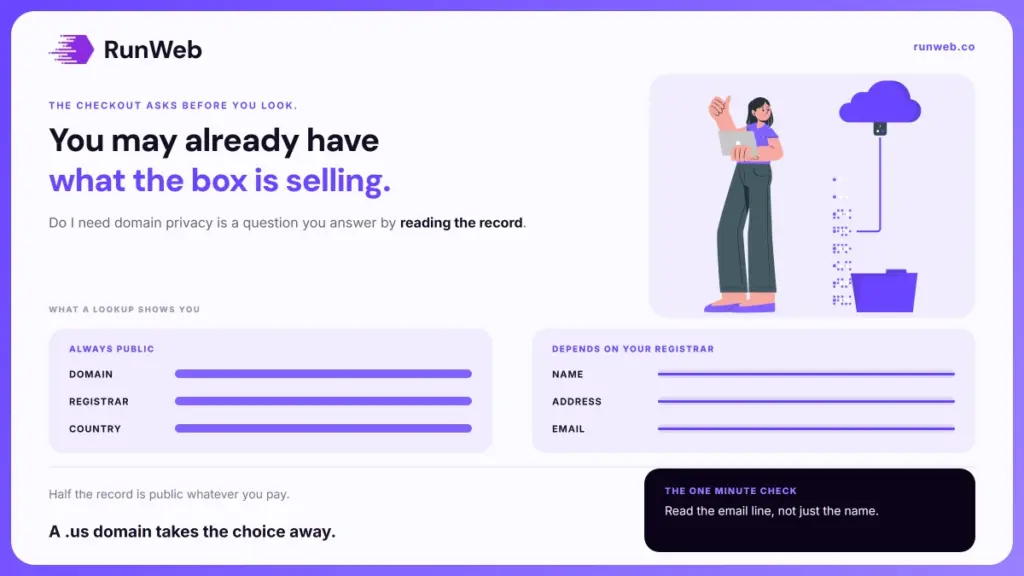
| What the record holds | Public either way | What redaction changes |
|---|---|---|
| The domain, its dates and its status | Yes | Nothing, these are always readable |
| The registrar holding the name | Yes | Nothing, and it is the useful field |
| The registrant country | Yes | Nothing |
| Registrant name and organisation | Depends | Removed or replaced |
| Street address and telephone | Depends | Removed or replaced |
| Registrant email | Depends | Swapped for a relay address or a web form |
Rows four to six are the product. And the last of them is the one most people care about, since a published address is what turns a new domain into a fortnight of cold calls.
Why yours may already be redacted
That distinction matters because the rules changed underneath the sales pitch. ICANN’s registration data policy took effect on 21 August 2025 and now governs what every accredited registrar publishes. The wording is careful. Under it, a registrar must redact personal data where the law requires that, and may redact it where the registrar has a commercially reasonable purpose of its own.
That is why plenty of owners who never bought anything find their details already hidden. Cost is the reason. Many registrars apply redaction across the board, because running one process for every customer is cheaper than running two.
The check takes about a minute, and it is worth doing before the renewal invoice arrives.
- Look the domain up: Use ICANN Lookup, the official registration data service, rather than a registrar’s own tool.
- Read the registrant block: Names like REDACTED FOR PRIVACY, or a privacy company’s address instead of yours, mean the job is done.
- Check the email line specifically: A web form link or a scrambled relay address counts as hidden. Your own inbox address does not.
- Then look at what you are paying: If the record is already redacted and a privacy fee is on the invoice, that is a question for your registrar.
Step two is where most people stop. Step three earns the minute. Because the email is the field that attracts the spam, a record showing a hidden name beside a live inbox has not solved the problem anyone bought it to solve.
The word that decides it
Once you have looked, the reason two businesses get different answers becomes easier to see. The policy splits in two. It obliges registrars to redact where some other law demands that, and it merely permits them to redact everywhere else.
That single word is why your competitor’s domain can be wide open while yours is blank, at the same price, in the same week. The registrar chose, and neither of you was asked.
Two further details are worth knowing, since both are commonly misdescribed by the people selling the service.
- Redaction is not anonymity: Where a registrar hides the registrant email, the policy still requires it to publish a relay address or a web form so the registrant remains reachable.
- Privacy and proxy are different products: A privacy service keeps your name on the registration and swaps the contact details, while a proxy service puts its own name on it instead.
- Nobody is accredited yet: ICANN describes its accreditation programme for these providers as still being implemented, so the company hiding your details answers to its own contract terms.
- The proxy version has a real cost: When another company is the named holder, untangling that later is slower than changing a contact field.
The third point is the one to weigh if you are choosing between products rather than deciding whether to buy at all. The two are not interchangeable. Paying a company to stand in front of your name is a different arrangement from paying it to hide your phone number, even where the checkout presents them as one tick.
The ending where it is not offered
All of that assumes an ending like .com or .net, where ICANN’s policy applies. Not every ending does. Some run their own rules instead, and one of them is common enough among American businesses to catch people out.
The registry behind .us states in its own published policy that it is required by United States policy, under its agreement with the Department of Commerce, to publish registrant data online through the usTLD lookup. Registrant name, postal address, email and telephone number are all listed as published fields. No fee changes that.
- If you already run a .us domain: Assume the record is readable and decide what address you are comfortable having in it.
- If you are about to register one: Weigh that against the ending you would otherwise pick, which is part of choosing a domain name.
- If you work from home: A registered business address or a mailbox service solves this better than a privacy product that the ending does not support.
The last option is the one worth acting on, and it helps beyond the domain record. Mailbox services are cheap. An address you are happy to publish is an address you can put on invoices, on your contact page and in your listings without thinking about it again.
The three things it does not hide
Even where privacy is available and switched on, the protection has edges. Owners read it as a general shield. What it actually governs is one record, which is narrower than the pitch suggests.
- Your registrar still knows: The real details sit in the account and are handed over under legal process, so the service hides you from the public rather than from the record.
- A trademark complaint goes through it: Dispute procedures reach the underlying holder, and a privacy provider is obliged to have a published contact for exactly that.
- Your own website undoes it: An address in your footer, your listings or your terms page is public regardless of what the registration says.
Point three cancels the purchase. Where a service business publishes its address for local search anyway, paying to hide the same address in a second place buys very little, though it still costs the renewal every year alongside the rest of what WordPress costs.
Settling it on your own domain
None of that produces a general answer. The honest one depends on facts only you can see, so two owners with the same business and the same budget can land in different places here, and both can be right.
- Look the record up first: If your details are already redacted, you are deciding whether to pay for a result you have.
- Ask what address you would publish: A commercial address you are happy to show removes most of the argument.
- Read the invoice line: Where privacy is bundled free, leaving it on costs nothing and is the easy default.
- Check the ending: A .us domain takes the choice away.
What to do if the record shows your home address
Turn privacy on where your registrar offers it, then change the underlying contact details to a business address once you have one. Both steps sit in the same account. Neither affects how the domain works or where it points, in the way that moving to a new host does.
And if you would rather this was decided properly at the start, along with who the accounts are registered to, that is how our websites service is set up, with what each tier includes broken out in the package tiers.
Frequently Asked Questions
Does hiding my details affect my search rankings?
Nothing in the registration record feeds ranking, and the field is not something search engines weigh. Your address matters for local search because of where you publish it, not because of the domain record.
Will my domain still work the same way?
Switching it on changes only which contact details are published. The name resolves exactly as before, and email routing, certificates and hosting are all untouched by the change.
Can I turn it off again later?
Most registrars let you toggle it in the account at any point, and the record updates within a day or so. Selling the domain is the usual reason people switch it off.
Is a free privacy offer worth less than a paid one?
The result is generally the same, since both replace the published contact fields. Read whether it is included permanently or only for the first year before assuming the renewal matches.
Do I need it on a domain I only use for email?
The record is created by registering the name, whether or not a website ever sits on it. A domain used purely for mail is published on exactly the same terms.