🎯 Key Takeaway
A realistic small business website cost in 2026 (US) is usually less about a single build quote and more about what you will spend over 36 months to keep the site secure, accurate, and generating qualified leads.
- 2026 pricing matrix: DIY vs freelancer vs agency ranges, plus what you actually get
- Hidden ownership costs: domain, hosting, security, updates, and the time tax on you or your team
- 3-year Total Cost of Ownership (TCO) plus break-even math by industry
- Ownership and portability checklist so you know what you keep if you leave
You will leave with a practical 3-year cost and ROI view so you can choose a path without sticker shock.
AI answers often mix $500 “I built it myself” examples with $15,000 agency builds and call them the same thing, which creates a real confusion gap for owners trying to budget responsibly. In the US in 2026, a reasonable overall range for a professionally usable marketing website is often $1,500 to $15,000+, depending on who builds it, how many pages you need, what integrations you rely on, and whether you operate in a higher-trust niche where accuracy and compliance matter. That is why the small business website cost conversation needs more than one number.
Cost is not the same as value, especially in healthcare, finance, logistics, and home services where one good lead can be meaningful, and one bad claim or broken form can be costly. This guide lays out a simple pricing matrix, the hidden ownership costs that show up after launch, a 3-year TCO and break-even calculator you can reuse, a practical “bill of rights” for ownership, and the 2026 red flags to watch for, including vague promises like “SEO included.”
The 2026 Pricing Matrix: What Different Build Methods Really Cost
Most US small businesses land in one of three paths: a DIY site builder subscription, a freelancer build, or a boutique agency build. Typical ranges can overlap, but pricing usually depends on scope (pages and content), integrations (booking, payments, CRM), compliance risk, and who is accountable after launch when something breaks or needs to change.
To reduce confusion, think in terms of what is included, not just the website design cost. A low build price may still be reasonable for a simple brochure site, while a higher website development cost can be justified when you need custom UX, tracked lead flows, accessibility considerations, or regulated-industry review.
DIY Builders (Best for Simple “Online Brochure” Needs)
DIY builders typically run about $15 to $50 per month plus your domain, and you can often publish quickly using templates. For some businesses, that is enough: a clean homepage, a services page, a contact form, and a way to be found. Where DIY often falls short is strategy, conversion-focused copy, technical setup, accessibility and compliance nuance, and clean tracking.
DIY is frequently a fit for a straightforward home services operator who needs an online presence, hours, service areas, and a contact pipeline, and it is often a poor fit for more regulated finance or healthcare workflows where wording, forms, and data handling deserve extra care.
DIY is usually a fit if…
- You need 1 to 5 simple pages and a basic contact form.
- Your services are easy to explain without custom calculators or complex funnels.
- You can write or revise your own copy and keep it updated.
- You are comfortable learning the platform and troubleshooting occasional issues.
- You do not need custom integrations beyond basic scheduling or email capture.
- You can tolerate limitations in design flexibility and portability.
- You have a plan for backups, access management, and security hygiene.
Freelancers vs Boutique Agencies (Where the Price Jump Comes From)
Freelancers commonly quote about $1,500 to $5,000 for a small business site, while boutique agencies often land around $5,000 to $15,000+ when strategy, content, tracking, and post-launch accountability are part of the scope. These ranges align with industry-reported budgeting guidance from Clutch, which summarizes how website scope and complexity can move costs significantly in the market, and should be read as directional rather than a universal price list (industry publisher guidance, no controlled study) in their website budgeting guide.
So what causes the price jump in real life?
- Custom UX and conversion planning: Not just “looks,” but page intent, calls to action, and fewer dead ends.
- Content production: Copywriting and page-by-page structure often take more time than owners expect.
- Integrations: Booking, payments, CRM, HIPAA-adjacent workflows, lead routing, or forms that do more than email you.
- Analytics and attribution: Knowing what channels produce leads, not just vanity traffic.
- Compliance sensitivity: Industry-specific review and careful claims language.
Freelancers may offer excellent value, but your risk is often continuity. If they are unavailable, you may be stuck. Agencies cost more largely because they are selling accountability across design, development, and ongoing changes. That accountability becomes more important as your small business website pricing moves from “online brochure” to “lead engine.”
If you want one accountable team from build to lead-gen operations, explore website design services for lead generation. Next, let’s talk about the costs that usually sit outside the build quote: the infrastructure you actually own and maintain.
Infrastructure: The “Hidden” Costs of Ownership (Domain, Hosting, Security)
The build price rarely includes all the plumbing you need to operate safely: domain registration, hosting, SSL, backups, monitoring, and security updates. These recurring costs are usually predictable, but the risk cost can surprise owners, downtime, security incidents, and performance problems that quietly reduce leads.
In other words, a “cheap build” can still come with a meaningful website setup fee in time and operational attention, even if there is not a formal invoice line item. The goal is not to overbuy, it is to budget for a reasonable website hosting price, maintain ownership, and reduce avoidable risk.
Domain Names: What You Pay Annually (and What to Avoid)
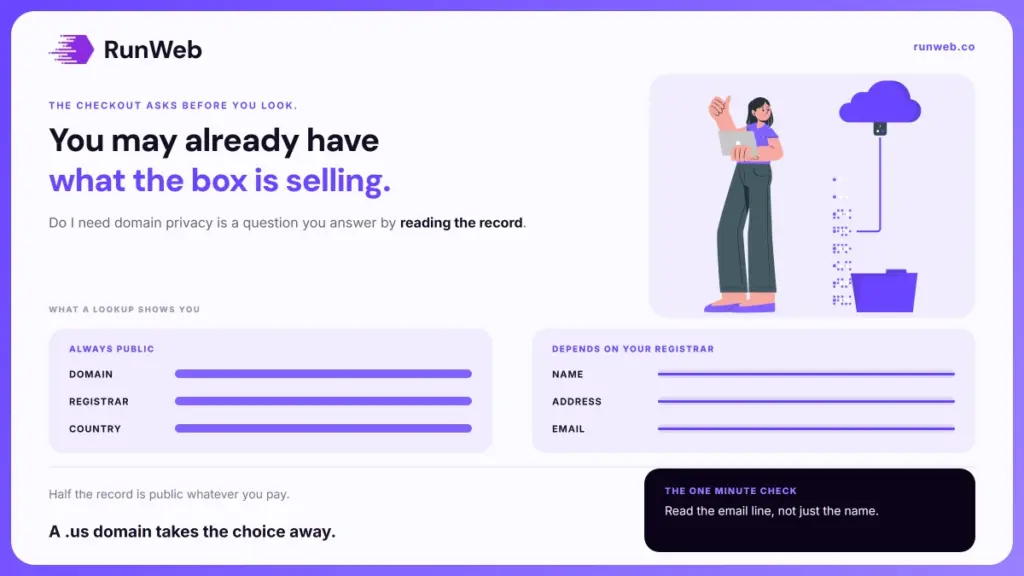
A typical domain name price is often about $10 to $30 per year, depending on the extension and registrar. The bigger issue is ownership: your domain should be registered in an account controlled by the business, not a vendor’s personal account. Edge cases include premium domains (one-time or high renewal pricing), privacy add-ons, and renewal surprises if you forget auto-renew settings or payment details.
Hosting: What “Good Enough” Costs in the US (and Why It Matters)
A baseline website hosting price for many small business marketing sites is often about $10 to $50 per month, and can increase with higher traffic, ecommerce, uptime expectations, or more complex applications. Hosting is not only a technical choice, it can affect how quickly pages load and how reliably forms work, which can be associated with lead volume and quality. That said, performance improvements do not guarantee conversion lifts, so treat hosting as risk management and user experience support, not a promise.
Here is a practical snapshot you can use when planning recurring ownership costs.
| Item | Typical Range | What it Covers | Common Gotcha |
|---|---|---|---|
| Domain | $10 to $30 per year | Your website name registration | Vendor controls registrar login and you cannot move it easily |
| Hosting | $10 to $50 per month | Server resources, uptime, basic support | Cheapest plans may throttle performance or limit support |
| SSL certificate | Often included, sometimes $0 to $200 per year | HTTPS encryption | Included SSL can still require renewal or correct installation |
| Backups | $5 to $30 per month | Restore points for files and database | Backups exist but are not tested, restore takes too long |
| Security monitoring | $10 to $100 per month | Scans, alerts, firewall features | Monitoring without response plan still leaves you exposed |
| Email or SMTP | $5 to $20 per user per month | Reliable sending for forms and notifications | Forms go to spam or fail silently without proper setup |
| Forms and anti-spam | $0 to $30 per month | Captchas, filtering, deliverability | Too aggressive filters block real leads, too weak invites spam |
If you want a single line item that bundles the operational basics, compare month-to-month options like month-to-month website maintenance and hosting. Next, we will put build and infrastructure into a 3-year view, so you can compare options on equal footing.
The 3-Year TCO & ROI Calculator (AI Gap #1 + #2)
The most practical way to compare options is a 36-month view that includes build cost, infrastructure, maintenance, and the owner time you spend managing changes and problems. When you translate that total into break-even customers or revenue, you can make a decision that fits your margins, not just your budget line. This is also where small business website cost estimates become easier to compare across DIY, freelancer, and agency paths.
The 3-Year Total Cost of Ownership (TCO) Framework (Plain-English Formula)
TCO is simply what you will spend to build, run, and keep the site healthy over time. A plain-English formula looks like this:
3-Year TCO = Upfront build + (Monthly infrastructure x 36) + (Monthly maintenance x 36) + Owner time tax
Where:
- Upfront build includes design, development, initial content, and basic tracking setup if scoped.
- Monthly infrastructure includes hosting, domain (annual divided monthly), email services, backups, and monitoring.
- Monthly maintenance includes updates, security checks, small content changes, and issue resolution. Your website maintenance cost depends on complexity and how frequently you change things.
- Owner time tax is the time you or a manager spends coordinating vendors, editing content, troubleshooting forms, approving changes, and handling access. Even a DIY site has a time tax, it is just paid in your hours instead of an invoice.
Why include maintenance at all? Security hygiene is a recurring process, not a one-time task. NIST’s small business cybersecurity basics emphasize practical steps like keeping software updated and maintaining backups as part of ongoing protection (government guidance, no trial) in NIST’s cybersecurity basics resource. Similarly, CISA’s guidance for managed service providers and small and mid-sized businesses discusses resilience practices such as backups and continuity planning as part of reducing impact when incidents happen (government guidance document, publication format) in the CISA Insights PDF.
Maintenance is not only about fear of hacks. It is also about avoiding silent failures: broken forms, expired plugins, tracking that stops working, or outdated service pages that lower trust. Monthly website maintenance packages can be useful when they define exactly what is covered, how fast issues are handled, and what is excluded.
Break-Even ROI Math (AI Gap #2): What the Website Must Produce to Pay for Itself
Break-even math is intentionally simple. You are not trying to predict the future perfectly, you are trying to see what is plausible given your margins.
Break-even customers over 36 months = Total 3-year TCO ÷ profit per customer (or profit per LTV)
If you prefer revenue instead of customers:
Break-even revenue = Total 3-year TCO ÷ gross margin
A few illustrative examples show how this plays out in high-trust niches. Use your real numbers if you have them, and keep in mind that close rate, seasonality, competition, and your response time can change outcomes.
| Industry | Example customer value | Example 3-year website TCO | Break-even customers over 36 months | Notes |
|---|---|---|---|---|
| Healthcare (dental or medical) | $800 profit per new patient | $18,000 | 23 | Higher scrutiny on claims and forms, lead quality matters |
| Finance (advisor or bookkeeping) | $1,500 profit per client | $24,000 | 16 | Trust signals and clear positioning can affect conversion rates |
| Home Services (HVAC or plumbing) | $350 profit per job | $12,000 | 35 | Speed to contact and mobile UX often matter for local leads |
Two important caveats:
1) These are illustrative numbers, not performance promises. Your break-even point can be higher or lower depending on your market and sales process.
2) Break-even is not only about SEO. Paid channels can provide faster feedback loops, but they still require solid landing pages and tracking to judge performance fairly. If paid acquisition is part of your plan, consider pairing the site build with Google Ads management for lead generation.
Finally, remember that the website itself is becoming a baseline expectation. The U.S. Small Business Administration reports that 73% of small businesses have a website (descriptive trend data, not a controlled study) in its small business trends post. That does not mean every business needs a complex site, but it does suggest you are competing in a world where prospects often expect to verify you online before they call.
Asset Ownership & Portability (AI Gap #3): Your Small Business Website Bill of Rights
Owning your website can mean owning the domain, hosting access, source files or code, CMS admin credentials, analytics accounts, content, and your Google Business Profile. If any of those are held back, you may be paying “rent” in the form of forced ongoing fees or a costly rebuild later, which can raise your future website redesign price.
This is not about distrusting providers. It is about reducing operational risk: if a vendor relationship changes, you should still be able to keep your digital assets and move them responsibly.
Ownership Checklist: What Should Be in Your Name (and How to Verify)
If you have ever asked, do I own my website, the most practical answer is: you own what you control access to, and what is stated in writing.
At minimum, confirm these items are in accounts controlled by the business:
- Domain registrar access (you can transfer it).
- Hosting account or administrative access.
- CMS admin access and user roles (not one shared login).
- Content library and brand assets (logos, photos, copy docs).
- Analytics ownership (Google Analytics and Tag Manager) with exportability.
Ask your provider these 8 ownership questions
- Who is the legal registrant on the domain, and can I see it in the registrar account?
- If we part ways, will you provide all admin logins and recovery emails?
- What platform is the site built on, and can it be exported or migrated?
- Do I get a full backup at handoff, and how is it restored if needed?
- Who owns the written content and design files after final payment?
- Are analytics and tag management in my company’s accounts?
- Where are form submissions stored, and can I export them?
- What ongoing services are optional vs required to keep the site functioning?
Portability Scenarios: What Happens If You Leave an Agency?
Portability depends on what you signed and what the site is built on. Common pitfalls include proprietary site builders that cannot be exported cleanly, withheld credentials, and “lease-to-own” setups where you never truly receive source assets. These arrangements are sometimes presented as convenience, but they can limit your options later.
You can reduce risk with a few neutral, practical steps: get handoff terms in writing, request periodic backups during the relationship, and document an export plan for content and analytics. If a provider is confident in their work, they can usually explain the handoff process without hesitation.
Why “SEO Included” Is a 2026 Red Flag (and What to Ask Instead)
“SEO included” often means basic technical setup, like indexability checks, titles, metadata, and a sitemap, not the ongoing work that typically drives growth such as content development, local visibility improvements, and conversion testing. In 2026, buyers should ask for clear deliverables, reporting definitions, and claim standards, particularly in regulated industries where wording and proof matter.
This also affects budgeting. The cost of SEO for small business can vary widely depending on whether you are buying a one-time setup or a monthly growth program, and whether it is coordinated with your broader small business advertising budget.
Technical Setup vs Ongoing Growth: Two Different Line Items
Technical setup is often a one-time scope item: analytics configuration, Search Console connection, basic on-page structure, XML sitemap, robots directives, and a baseline local listing check. Ongoing growth is different: publishing helpful content, refining local landing pages, improving conversion flows, and iterating based on performance data.
If you are comparing proposals, ask providers to separate “setup” from “ongoing” and to define what reporting you will receive and how often. The University of Houston SBDC’s digital marketing trends resource summarizes evolving channel expectations for small businesses (trend synthesis, not a clinical study) and can be used as context for why clarity matters in 2025 and beyond, in its digital marketing trends page.
If you are also preparing for more AI-driven discovery, ask whether the plan includes content and structured information that helps your services be understood in multiple search experiences. If that is relevant to your goals, review AI search optimization (GEO) services so you can compare deliverables apples to apples.
Compliance & Claims: Why High-Trust Industries Need Extra Care
In healthcare and finance especially, marketing claims can create risk if they are overstated, unclear, or hard to substantiate. The FTC’s business guidance on advertising explains that ads should be truthful, not deceptive, and supported by evidence (regulatory guidance, not a study) in its Advertising and Marketing Guidance. The FTC also maintains a truth-in-advertising topics hub that reinforces these principles (regulatory topics resource) on its Truth in Advertising page.
Practically, this means you should treat website copy, landing pages, and ad messaging as one system. If a provider promises outcomes or uses aggressive wording without discussing substantiation and review, that is a signal to slow down and ask better questions.
Conclusion
By now you have a clear way to compare build paths, a shortlist of infrastructure costs that tend to show up after launch, a 3-year TCO formula with break-even math, and a simple ownership checklist to reduce lock-in. The small business website cost you choose should match your industry risk, your sales process, and the level of accountability you need after launch, not just a one-time build quote. Real budgets vary based on scope, integrations, and how much content and tracking you need to support growth.
If you want an accountable alternative that keeps everything transparent, with one team and one invoice, RunWeb offers done-for-you website, maintenance, and growth support with month-to-month plans, no contracts, and cancel-anytime flexibility. Request a quote.
Frequently Asked Questions
These FAQs cover the most common 2026 US pricing, maintenance, and ownership questions small business owners ask when comparing DIY tools, freelancers, and agencies. The numbers below are general benchmarks, and real costs depend on scope, integrations, compliance needs, and how aggressively you want to grow.
How much should I pay for a website for my small business?
A typical budget is about $1,500 to $15,000+ depending on scope and who builds it. A 5 to 10 page marketing site with basic tracking often sits on the lower end, while booking, ecommerce, custom integrations, and compliance review tend to push costs up. A cheap build can become expensive if maintenance and lead tracking are missing.
How much does it cost to maintain a website?
Many small businesses spend roughly $50 to $300 per month for maintenance, with higher ranges for complex sites. Core items usually include backups, software updates, uptime or security monitoring, and small content edits. Ecommerce, frequent promotions, or regulated data handling can require more time and tighter processes, which can raise monthly costs.
Do websites need monthly maintenance?
Most websites benefit from at least monthly maintenance because software, plugins, and security practices change over time. Updates, backups, and basic monitoring can reduce the chance of avoidable outages or vulnerabilities. A mostly static site with minimal plugins may need less frequent work, but unpatched software can increase risk the longer it goes untouched.
Do I own my website and content if I stop working with an agency?
You usually own what your business controls in writing and in account access: domain, hosting, CMS admin, files, and content rights. A practical check is simple: who controls the registrar login and the admin recovery email? A common gotcha is a proprietary platform or “lease” model that limits export or migration when you leave.
How long does it take for SEO or Google Ads to show results?
Google Ads can often generate signals in days to weeks, while SEO commonly takes months to show meaningful momentum. Timelines vary based on competition, budget, tracking quality, and whether your landing pages match search intent. Before judging either channel, ensure conversion tracking works and the pages are built to convert, otherwise performance can look misleading.