🎯 Key Takeaway
- Most SEO vs Google Ads money is lost to mechanics, not to picking the wrong channel
- Ads can produce clicks the same day, while search work compounds over months, so running both on a small budget usually underfunds each
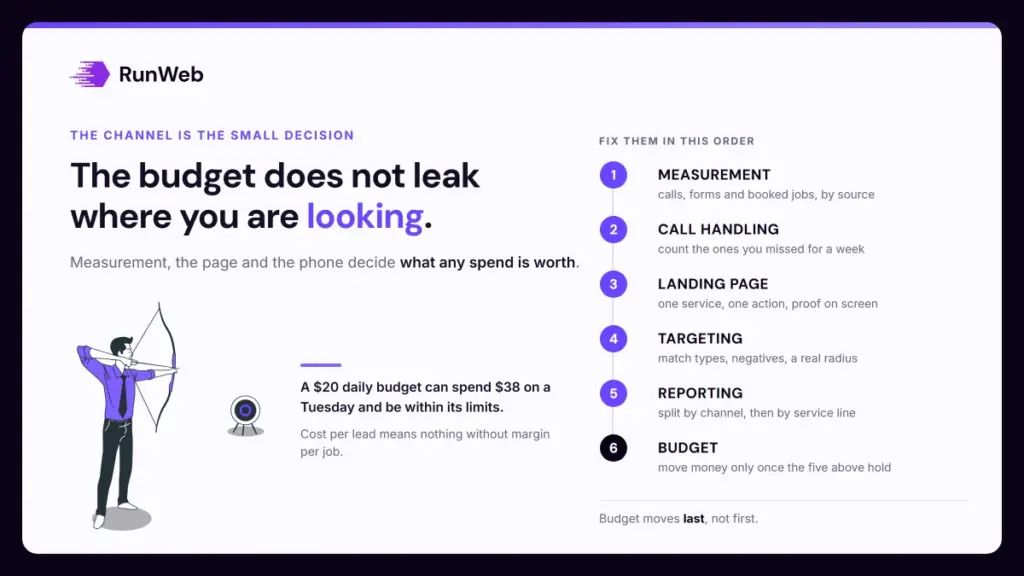
- Google spends up to twice your daily budget on a given day and caps the month at 30.4 times it, which is why daily figures look wrong
- Tracking clicks instead of booked jobs makes every later decision a guess, and it is the most common leak of the nine
- Fix measurement, the landing page and call handling before touching bids, because those three decide what any spend is worth
Most wasted search budget is lost to plumbing, not to backing the wrong horse.
Ads can bring clicks today and search work compounds over months, so the two suit different problems. That part is well understood.
What quietly drains money is everything around the channel: a page that doesn’t convert, a phone nobody answers, and reporting that counts clicks instead of jobs.
So here are the nine leaks that do the damage, and the order worth fixing them in.
Why the channel choice is not the expensive decision
SEO vs Google Ads gets framed as a strategy question when it is mostly a timing one. Semrush puts it plainly: ads can deliver near-instant results where the same day can bring clicks and conversions, while search work takes months and compounds.
Both descriptions are accurate, and neither tells you where your money went. A business can pick correctly and still waste most of a year’s budget.
Cost is the other half. Ahrefs makes the scale vivid by pricing its own organic traffic as paid clicks and arriving at a figure in the millions a year, which is the argument for search work in one number.
That number takes years to earn, though. So most service businesses run ads while the slower work matures, and splitting a small budget across both before either is working leaves two underpowered programmes instead of one that pays.
Two half-funded channels generate half the data each and none of the confidence. Pick one, prove it, then add the second.
The nine leaks
Each of these costs money regardless of which channel you chose. Most are fixable inside a month, and none needs a specialist.
| The leak | What it looks like | The fix |
|---|---|---|
| Splitting a small budget | Two campaigns, neither with enough volume to learn from | Fund one properly for 30 days, then add the second |
| Paid clicks to the homepage | High bounce, low calls, and no idea which service was wanted | One page per core service, one action on each |
| Counting clicks, not jobs | Busy reports that cannot be tied to booked work | Track calls, forms and bookings, reviewed weekly |
| Buying broad terms | Budget spent on searches with no buying intent | Tighter match types, negative keywords, a real service radius |
| Automation without limits | Queries and placements you would never have picked | Start restricted, read the search terms, loosen on evidence |
| Quitting search work early | Stopping after a few pages because nothing moved by week six | Commit to a quarter on a small set of pages |
| Ignoring the conversion rate | Paying for traffic that meets a long form and thin proof | Shorter forms, visible proof, an obvious phone number |
| Blending channel metrics | One cost per lead that hides which source is failing | Report by channel, then by service line |
| A neglected profile | Ads running while the map listing is thin or wrong | Fix categories, services, photos and reviews first |
Read the middle column before the third. Most owners recognise two or three immediately, and those are the ones to start with.
That ninth row deserves particular attention, since the profile affects both channels at once. Someone who clicks your ad often checks the map listing before calling, and how long local SEO takes covers what fixing it involves.
The budget mechanic that confuses everyone
Daily spend in Google Ads almost never matches the daily budget, and this causes more panicked emails than any other part of the platform. The behaviour is documented and deliberate.
Google states that on some days you might not reach your average daily budget and on others you might exceed it, with a daily spending limit of twice your average daily budget for most campaigns. The monthly charge is capped at 30.4 times that average.
- A $20 daily budget: Can spend up to $40 on any single day and stay inside its limits.
- The month, not the day: Capped at 30.4 times the average, so $20 a day means about $608 across a month.
- What causes the swing: Google weights spend towards days when clicks and conversions look more likely.
So checking daily spend against the daily number produces a false alarm most weeks. Judge the month instead, and a recurring argument disappears along with the campaigns paused on a normal fluctuation.
What a lead has to be worth
One figure decides whether any of those leaks matters: the most you can pay for a customer while still making money. Working it out takes two numbers you already have.
Start from margin instead of revenue, because revenue makes any spend look justified. A job billing $2,000 at a 35% gross margin contributes $700, and that $700 is what your marketing has to come out of.
Then apply your close rate. If one in four enquiries becomes a job, four leads produce $700 of margin, so a lead is worth about $175 before you have made anything at all.
Then set your ceiling below it. Paying $120 a lead against a $175 break-even leaves $55 of actual profit, and it tells you immediately whether a campaign running at $200 a lead is worth optimising or switching off.
Cost per lead means nothing on its own. Cost per lead against margin per job is a decision.
Those two numbers also settle the channel argument without an opinion in it. Where ads clear the ceiling comfortably you fund ads, and where they cannot, the slower work is the only route that gets there.
Fixing them in the right order
Order matters more than speed here, because fixing bids before measurement means you cannot tell whether the fix worked. Work down this list rather than across it.
- Measurement first: Calls, forms and booked jobs recorded against their source. Until this exists, every other change is unverifiable.
- Call handling second: Count missed calls for a week. Answering more of them is usually the cheapest lead generation available to a service business.
- The landing page third: One service, one action, proof visible without scrolling. Paid traffic amplifies whatever the page already does.
- Targeting fourth: Tighten match types, add negatives from the actual search terms, and set the radius to where you will really travel.
- Reporting fifth: Split by channel and service line, so a weak source stops hiding inside an average.
- Budget last: Move money only once the four above are stable, since reallocating on bad data is how the same mistake gets funded twice.
Most of that list is unglamorous, and none of it involves the channel debate at all. Which is the point: the choice between them is a small decision sitting on top of six larger ones.
Where ad formats are the open question, Local Service Ads covers which fills fastest, and Yelp Ads covers the choice when only one is affordable. If the site itself is the constraint, what a package includes names the tracking and conversion work that usually is not in it.
When you would rather have one team running both sides against a single cost-per-job number, our Google Ads management works to that figure.
Frequently Asked Questions
Is ten dollars a day enough to test Google Ads?
It can work as a learning test on one service in a tight radius with exact keywords, though competitive trades will burn it on a handful of clicks. Give it a fortnight and judge lead quality, not click volume.
Do Google Ads improve organic rankings?
Running ads has no direct effect on where you rank in unpaid results. The useful overlap is data, since ad search terms show which phrases actually produce enquiries and that tells you what to write about.
How long before I can judge an ads campaign?
Two to four weeks of steady spend usually produces enough enquiries to see a pattern in quality. Judging it in the first few days mostly measures the learning period rather than the campaign.
Should I pause ads once search traffic arrives?
Taper instead of stopping, and watch total enquiries rather than each channel separately. Many businesses find the two capture different buyers, so cutting one reduces the total more than expected.
What if my cost per lead is above my break-even?
Look at the landing page and call handling before the bids, since both change cost per job without changing what you pay per click. Switch the campaign off only when those two are already good.