🎯 Key Takeaway
- Yelp Ads vs Google Ads is a choice between renting space on a page Yelp owns and buying clicks to a page you own
- Google Ads charges per click, and the daily budget behaves as an average, so the monthly total is the number to watch
- Yelp works hardest where the buyer is comparing vendors, and worst where the job is an emergency
- Neither platform reports the other’s leads, so a fair comparison needs two tracking numbers before it needs opinions
- Cost per booked job is the only figure that settles it, and neither dashboard will calculate it for you
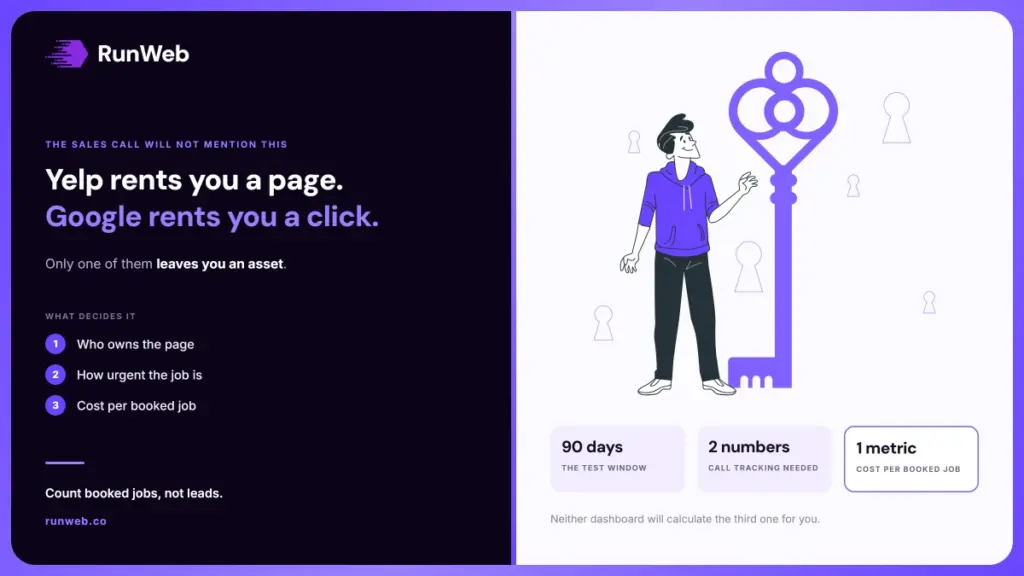
Yelp sells you space on a page Yelp owns. Google sells you clicks to a page you own. Almost everything else people argue about follows from that one difference, and most comparisons never mention it.
Meanwhile a Yelp rep is on the phone quoting a monthly figure and calling the leads exclusive, your Google Ads account is spending its budget on something, and nobody in the office can say which of the two produced last month’s four jobs.
That’s the position most home service businesses argue from, so the argument rarely settles. Both platforms report their own performance generously. Neither reports the other at all.
So here’s what each one actually rents you, then a way to decide it on your own numbers instead of on a sales call.
What you are actually renting from each
Both products charge for clicks. That shared mechanic is what makes them look like a straight swap, and it hides the thing that matters, which is where the click lands.
Yelp Ads raise your placement inside Yelp’s own search results and app, then send the visitor to a profile sitting on Yelp’s domain in Yelp’s layout. That’s how Yelp Ads are described by Yelp. Google Ads put a listing in Google’s results and send the visitor to a page on your website.
So the money buys visibility either way. But only one of the two leaves you owning something afterwards, because clicks that land on your own site deposit analytics you keep, an audience you can advertise to again, and a page you can change on a Tuesday afternoon without asking anyone.
Who controls the page the click lands on
Ownership stays abstract right up until something goes wrong. Yelp’s software decides which of your reviews to show. The template changes underneath you. There’s no earlier version to roll back to, and no setting that overrides either.
The same limitation applies to your Google Business Profile, and it’s worth admitting that, because that page also lives on somebody else’s platform. What separates the two paid products is direction of travel. Google’s sends traffic onto your site. Yelp’s keeps it inside Yelp.
How the two price a lead
Once the destination is clear, pricing gets easier to read. Google Ads runs an auction on every search, and you pay the actual cost per click, which is frequently below your maximum bid.
Your daily budget then behaves as an average rather than a hard ceiling. Google may spend over it on a busy day and under it on a quiet one, while capping the monthly total near thirty times the daily figure. That matters the moment you set a Yelp package quoted per month against a Google budget quoted per day.
| What you are comparing | Yelp Ads | Google Ads |
|---|---|---|
| Where the click lands | Your profile on Yelp’s domain | A page on your own website |
| What you bid for | Placement in Yelp categories and search | Keywords typed into Google |
| How it is sold | Cost per click, packaged as a monthly spend | Cost per click, budget set per day |
| Who controls the page | Yelp, including layout and review display | You |
| Typical commitment | Monthly or annual agreement | Pausable on any day |
| What you keep afterwards | Reporting inside Yelp’s dashboard | Analytics, audiences and conversion history |
| Where it fits best | Considered work chosen after comparison | Urgent searches with immediate intent |
| What it asks of you | Photos, reviews and a complete profile | A landing page that converts |
That table is most of the argument on one screen. Two rows deserve a second look, and the first is commitment, because a monthly or annual agreement takes away your ability to stop spending through a slow month.
The second is what you keep. A channel whose data lives in somebody else’s dashboard is a channel you’ll still be arguing about next year, because you can never audit it yourself.
What a monthly package hides
Yelp quotes a month. Google quotes a day. So the two are easy to misread against each other, and a daily budget of forty dollars comes to roughly twelve hundred a month, which sounds heavier than it is until you put it beside a package sold as one number.
Convert both to the same unit before deciding anything. Then ask what each one looks like in January, because a channel you can pause on a quiet Tuesday is worth real money over one you can’t, and that flexibility never appears as a line on either quote.
Where Yelp Ads earn their money
Those columns make Yelp look like the weaker buy, and for several trades that reading is wrong. Yelp holds a particular kind of visitor: somebody already comparing three vendors rather than hunting for a fix.
That mindset suits work where reviews and photographs do the selling, which covers remodelling, moving, landscaping and dental practices. If your jobs get chosen after a long browse rather than during a crisis, Yelp’s audience sits closer to your buyer than Google’s cheapest clicks do.
Where it earns much less is urgency. A burst pipe at 11pm produces a Google search and a phone call inside two minutes, and nobody opens a review app to read four profiles while the kitchen floods.
Urgency is also where Google’s second ad product does its best work, covered in Local Service Ads.
The category question worth asking first
Before funding either channel, listen to how your own customers describe finding you.
- “I asked around and then checked reviews”: That’s a Yelp path, and it usually means a considered purchase with a shortlist behind it.
- “You came up first when I searched”: That’s a Google path, and it usually means the job was already decided before the call.
What Google Ads asks of you that Yelp does not
Sending clicks to your own site is the advantage. It’s also the catch, because your page now has to do the work Yelp’s profile was doing for you, and a Yelp listing arrives with reviews, hours, photographs and a call button already assembled.
So before you fund Google Ads, the landing page needs the same furniture.
- A tappable phone number: Most service searches on Google happen on a phone, so a number that has to be copied out by hand loses calls that were already decided.
- Your service area written in words: A visitor who cannot tell whether you cover their town will leave rather than ring to ask, and a map embed alone does not answer the question.
- Price ranges wherever you can give them: Naming a range filters out the enquiries you would have turned down anyway, which raises your booked rate even as it lowers your lead count.
- Reviews shown on the page: Pull the text onto the landing page rather than linking away to a review site, since a link out is a click you paid for and then gave back.
- One action per page: A page offering a call, a form, a quote tool and a newsletter is a page that gets none of them, so pick the action you want and let it dominate.
Even the unpaid side rewards the same work. Google’s local ranking guidance names relevance, distance and prominence as what earns visibility, and those three also explain why a thin landing page converts badly while the ad itself looks fine.
How to settle it on your own numbers
All of that stays theoretical until you run the test, and the test costs less than a quarter of misdirected spend. Ninety days and two tracking numbers will answer this for your business better than any article can, including this one.
- Give each platform its own tracking number: One number on the Yelp profile and a different one on the landing page means a call can be traced without asking the caller to remember where they found you.
- Fix the window before you start: Run both for a full ninety days, because a single month landing in your slow season will mislead you in whichever direction it falls.
- Count booked jobs rather than leads: A platform sending twelve enquiries that book one is losing to a platform sending four that book three, and only the second number pays wages.
- Divide spend by booked jobs: Cost per booked job is the figure that makes the two comparable, and neither dashboard will work it out for you because neither can see the other side.
- Log who answered the phone: Missed calls are the commonest reason a channel looks weak in a test, and that fault belongs to neither platform.
- Read the result once, then act: Move the budget at ninety days rather than after a disappointing fortnight, since paid channels are noisy over short windows.
Those six steps turn a sales call into a decision. If Yelp books work at a lower cost per job, keep funding it. If the reverse holds, move the money without waiting for the contract to remind you.
Which one to fund first
That test assumes you can fund both for a quarter, and plenty of businesses can’t. With one budget on the table, the deciding question is whether your website is ready to receive a click at all.
If the site converts, Google Ads is usually the better first spend, because every click also builds analytics and an audience that outlive the campaign. If it doesn’t convert yet, Yelp buys you time, since its profile does the persuading while the website gets fixed behind it.
If neither is affordable this quarter
With no budget for paid clicks, the money goes much further on the profile and the page. A complete Google Business Profile, real photographs of finished work and twenty recent reviews will beat a thin ad budget split across two channels.
And that groundwork makes the eventual ad spend cheaper, because both platforms reward a listing people click and then stay on. The order to do it in is in local search for contractors, and which parts show up in weeks rather than quarters is in how long SEO takes.
The page those clicks land on matters as much as the channel, so check your page count first, and small business website costs if the build itself is the constraint.
If you’d rather not spend a quarter finding out the hard way, our Google Ads management service opens by auditing the page those clicks would land on.
Frequently Asked Questions
Can you run both platforms at the same time?
Running both is common, and it is the only way to compare them fairly. Use separate tracking numbers so each platform’s calls stay attributable, then give the test a full quarter before reading anything into the result.
Does advertising on Yelp change which reviews are shown?
Yelp’s published position is that its recommendation software operates independently of advertising. Businesses that stop paying sometimes report a dip, though separating that from ordinary seasonal movement is difficult without a baseline recorded beforehand.
What monthly budget makes a paid test meaningful?
Enough to buy a useful number of clicks in your trade, which for most home services means several hundred dollars a month rather than fifty. A budget too small to produce ten leads cannot tell you anything either way.
Which platform produces better quality enquiries?
Quality tracks urgency more than platform. Emergency work converts better from Google, because the searcher wants somebody immediately, while planned work such as remodelling converts better from Yelp, where the visitor is already shortlisting firms.
What happens to your listings if you stop paying?
Google Ads stops delivering the moment a campaign pauses, and your unpaid listings carry on unaffected. A Yelp profile also stays live, though it loses the placement that had been putting it above competitors in category searches.