🎯 Key Takeaway
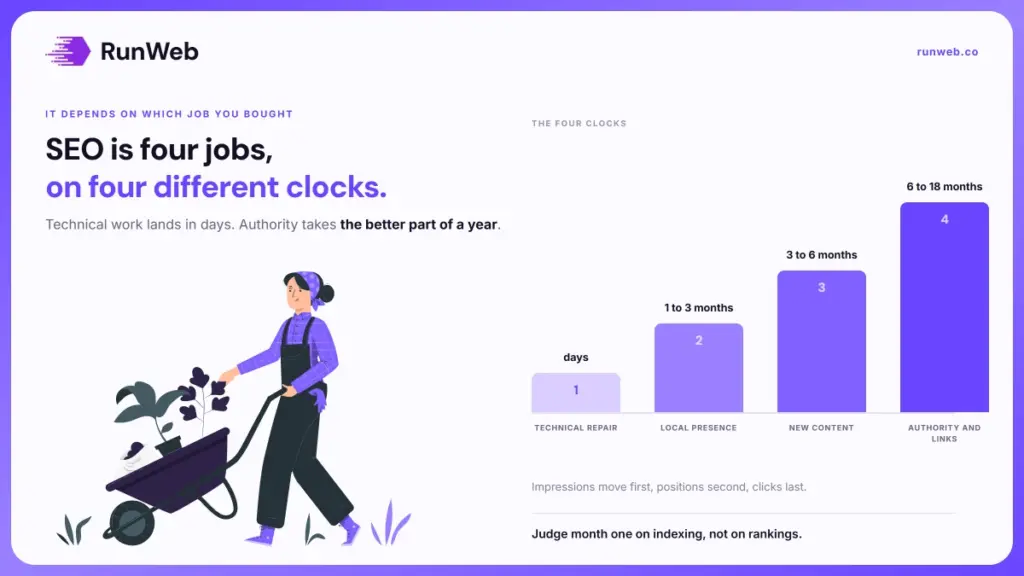
- How long does SEO take has no single answer, because the word bundles four jobs that run on four different clocks
- Technical fixes can register within days once Google recrawls the pages you changed
- Local visibility moves in weeks, since a profile and review signals update faster than a whole site does
- New content usually needs three to six months, and competitive authority takes quarters rather than months
- Judge month one on indexing and impressions, not on rankings or leads, or you will cancel something that was working
Technical fixes can show up within days. Authority on a competitive phrase takes closer to a year. Both of those get sold as SEO, so anyone who answers this question without asking you a question back first is guessing.
Six weeks into a retainer somebody raises it in a meeting, and the agency says “SEO is a long-term play”. Everyone leaves the room with a different number in their head, nobody writes theirs down, and four months later the two sides are having an argument that was baked in on day one.
It’s avoidable.
The word covers four separate jobs, and each one reports back on its own schedule. Here’s the clock for each, then what you should actually be looking at in month one and month three, so progress and stagnation stop looking identical.
Why the question has four answers
Somebody asking this is usually holding one specific hope. Ranking for the phrase a competitor owns, say, or getting the phone to ring by spring. But the work they bought was a bundle, and the fast parts of it finish long before the slow parts start showing.
The four jobs are technical repair, local presence, content, and authority. They share a name and almost nothing else.
That split is sharpest for a trade business, where the local clock does most of the visible work while the others run underneath it. Which of the four to fund first is covered in local search for contractors.
Why bundling them causes the argument
An agency reports on all four together. So month two looks busy, even though nothing has moved on the phrase you actually cared about.
Both things are true at once. The technical work did land, and the content that will answer your question hasn’t been crawled yet.
A contractor who wants the phone ringing next month and a firm that wants to own a category by 2028 are buying different products under one label. Neither is wrong. They just shouldn’t share a report.
So the conversation worth having at the start is which of the four you’re buying, and in what order.
The four clocks, and what each one runs on
Those four depend on different mechanisms, and that’s what sets their pace. Technical changes wait on a recrawl. Authority waits on other people deciding to link to you, which you don’t control and can’t schedule.
| The job | First visible movement | What it is waiting on | What you see change |
|---|---|---|---|
| Technical repair | Days to 3 weeks | Google recrawling the changed pages | Indexed page count, coverage errors clearing |
| Local presence | 2 to 8 weeks | Profile completeness, reviews, proximity | Map pack appearances, calls and direction requests |
| New content | 3 to 6 months | Crawling, then accumulating engagement signals | Impressions first, then positions, then clicks |
| Authority and links | 6 to 18 months | Other sites choosing to reference yours | Movement on competitive head terms |
| Reclaiming lost rankings | 4 to 12 weeks | Reprocessing after the fault is fixed | Positions returning towards their old range |
Two things in that table explain most of the frustration. The job with the fastest clock is technical repair, and it’s the one clients care least about, so genuine progress in week two feels like nothing happened.
The second is worse. Impressions move before positions, and positions move before clicks, so a campaign can be working for eight weeks while every number an owner would naturally check sits flat.
What Google itself says about the delay
None of that staging is an agency excuse. Google’s SEO starter guide says plainly that changes can take time to show, and that some may never produce a visible effect at all.
The reason sits in how the machine is built. Google’s account of how Search works splits crawling, indexing and serving into three stages. A page you published this morning has to be found, then processed, then judged worth showing. Only then can it rank.
Independent measurement agrees. Ahrefs looked at pages that reached the top ten and found most took over a year to get there, while Semrush puts meaningful movement in the three to six month range for a typical site.
Why a new domain waits longer
And those figures stretch further on a site with no history, because Google has nothing to go on. An older domain gets crawled more often and carries signals already, so the same article ranks faster on a five-year-old site than on one registered last month.
That’s unfair. Budget for it anyway.
What to measure at 30, 60 and 90 days
The four clocks report at different times, so one dashboard read a month tells you very little. Picking the right measure for each stage is what stops a working campaign getting cancelled in month two.
- Day 30, check indexing: Confirm in Search Console that the pages you changed have been recrawled and that coverage errors are falling, because nothing else can happen until that does.
- Day 30, check impressions: Impressions rising while positions sit still is the earliest honest sign of progress, and it arrives well before any ranking does.
- Day 60, check position bands: Look for pages moving from nowhere into positions eleven to thirty, since that is the queue that later produces page-one results.
- Day 60, check local signals: Where local work is part of the brief, calls and direction requests from your profile should already be moving.
- Day 90, check clicks: By now click growth should be visible on at least some pages, and if impressions grew while clicks did not, the problem is titles and descriptions rather than the SEO.
- Day 90, check leads: Compare enquiries against the same quarter last year rather than last month, because seasonality will otherwise write the story for you.
Those six also give you something to hold a supplier to. A report full of activity but missing all six is a report about effort, not results.
What a monthly report should actually contain
The measures arrive in a fixed order, so a useful report follows that order instead of leading with whatever looks best. In the early months indexing and impressions belong at the top, because they’re the only numbers capable of moving yet.
A report that opens with keyword rankings in month one is showing you a number that couldn’t have changed. That isn’t always dishonesty. But the reader still learns nothing about whether the work is landing.
Ask for one page with those six figures, each compared against the same month last year rather than last month. If a supplier can’t produce it, the reporting is the problem before the SEO is.
What makes it take longer than it should
All of those timelines assume the work isn’t fighting the site it sits on. When they stretch, the cause is usually one of a handful of things that have nothing to do with the SEO itself.
- Content approval sitting in a queue: An article waiting three weeks for sign-off has spent three weeks not being crawled, and that delay compounds across every piece behind it.
- Publishing in bursts: Twelve articles in one week and nothing for two months gives Google less to work with than one a week for twelve weeks.
- A slow or unstable site: Crawling is throttled by what your server can serve, so hosting problems quietly slow every other job in the bundle.
- Changing the target every month: Repointing the keyword set each month restarts the slowest clock in the bundle without ever finishing it.
- No internal linking: A new page with nothing pointing at it is harder to find and slower to judge, which is why page count matters less than how the pages are joined up.
- A redesign landing mid-campaign: Changing URLs restarts the reprocessing clock, and the redesign timeline shows where that window belongs.
Every one of those is a decision, not a technical limit. Fixing the approval queue costs nothing and shortens every timeline in the table above.
When to conclude it is not working
There’s still a point where patience becomes denial, and it arrives earlier than most agencies suggest. Missing rankings isn’t the signal, because rankings are the last thing to show up.
The signal is stillness in the earlier measures. Your changed pages have been recrawled, ninety days have passed, impressions haven’t grown, and no page has reached the eleven to thirty band. That combination points at the targeting, not the timeline.
Three questions before you renew
So take three questions into the renewal conversation instead of a general impression. Each has an answer you can check in Search Console while you’re still talking.
- Which pages have been recrawled since the work started? A supplier who cannot name them has not verified that anything they changed reached Google at all.
- Which queries gained impressions, and by how much? Growth concentrated on your own brand name is not the same as growth on the work you commissioned, and the two are easy to present as one number.
- Which pages sit in positions eleven to thirty today? That band is the pipeline for next quarter, so an empty band after ninety days means there is nothing queued behind the current numbers.
If all three have real answers, the timeline is doing what it should and the spend is buying position. If none of them does, another quarter buys you the same meeting.
Whether the numbers justify the spend is a separate sum, and the SEO ROI calculator will do it against your own average job value.
Most businesses cover the wait with paid search. Which format fills fastest is in Local Service Ads.
And if you’d rather start from a plan that names what moves in month one and what doesn’t, our SEO service opens with the audit that sets those expectations.
Frequently Asked Questions
Can paid ads shorten the wait?
Paid search fills the gap while the unpaid work matures, and it also produces keyword data worth reusing. It does nothing to accelerate the underlying rankings, so treat it as cover rather than as a shortcut.
Does publishing more often speed things up?
Steady publishing helps more than volume does, because it gives Google a predictable reason to return. Twelve strong pages across twelve weeks will outperform thirty thin ones shipped in a fortnight.
How long before a fixed technical fault recovers?
Recovery normally follows the next full recrawl of the affected pages, which is days on a well-crawled site and several weeks on a slow one. Requesting indexing for the most important pages shortens it.
Is a six-month contract reasonable?
Six months is defensible for content and authority work, since neither reports back sooner. Ask for the month-one and month-two measures in writing, so the term is not the only thing you have agreed to.
Why did rankings arrive and then slip back?
Early positions often settle down once Google gathers engagement data on a new page. A drop from position eight to fifteen in week three is normal recalibration rather than evidence the work failed.