🎯 Key Takeaway
- SEO for contractors is mostly a service-area problem, because you sell one trade across many towns rather than many products in one place
- Your Google Business Profile earns more of the visible result than your website does, and proximity is a factor you cannot change
- Twelve near-identical town pages compete with each other, so build them only where you have real evidence to put on them
- Reviews arriving steadily beat a large batch collected once, and they carry the town names you are trying to rank for
- LocalBusiness markup helps a crawler read your area and hours, though it does not substitute for the profile
Most search advice assumes a business selling many things in one place. A contractor is the exact reverse, selling one trade across a wide area, and nearly every difficulty in this job comes out of that inversion.
So a firm covering twelve towns from one yard gets handed a content calendar and a diagram about topic clusters. Meanwhile the real question sits there unanswered: why does the outfit three towns over keep winning jobs you’d have driven to happily?
Here’s what actually moves visibility for a trade business, in the order it matters, including the point where the standard advice to build a page per town starts doing damage.
Why contractor SEO is a service-area problem
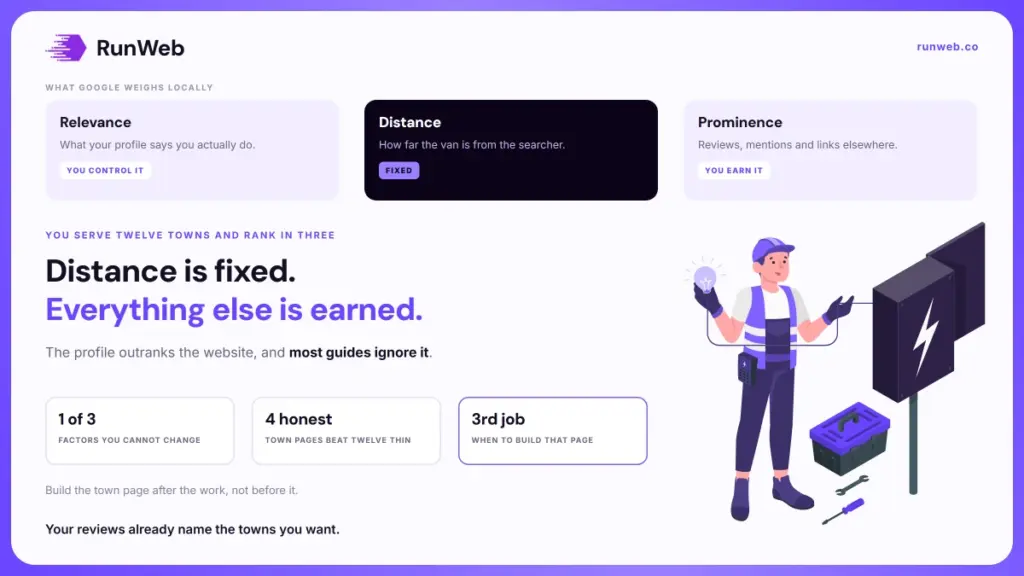
When a homeowner searches for a trade, Google is answering a question about geography as much as about quality. Its local ranking guidance names relevance, distance and prominence as the three inputs. One of those three was fixed the day you signed your lease.
Distance is why that firm three towns over wins work you’d take. They’re nearer to the person searching, and no amount of content moves your yard.
What you can move, and what you cannot
So the work divides cleanly. Relevance and prominence are yours to earn. Distance is a constraint to plan around, not a problem to solve.
Most contractor SEO gets that planning wrong. Chasing the town at the far edge of your radius costs more than owning the three nearest ones, and the nearest three are exactly where your reviews and your drive time already hand you an advantage.
| What agencies usually sell first | What actually moves a trade business | Why the order matters |
|---|---|---|
| A page for every town in the radius | A complete Google Business Profile | The map block sits above the results and answers without a click |
| A monthly blog schedule | One page per billable service | Service pages match how customers actually search |
| Keyword reports | Reviews arriving steadily, naming towns | Reviews feed the map result and no competitor can copy them |
| Backlink packages | Photographs and dates from finished jobs | Evidence converts the traffic the other work earns |
| Technical audit deliverables | LocalBusiness markup on the pages that matter | Helps a crawler read your area and hours without guessing |
| Ranking guarantees | Honest service-area settings | Claiming thirty towns dilutes the signal for the four you serve |
Nothing in the left column is worthless. It’s sequenced wrongly, that’s all. Every item in it works better once the middle column exists, which is why an agency leading with town pages is selling you the last step first.
The profile does more work than the website
The ordering of effort surprises people. For a trade business the Google Business Profile carries more of the visible outcome than the website does, because the map block sits above the ordinary results and answers the question without a click.
It’s also where the details Google checks actually live, so a mismatch there undermines everything built on top of it. Google’s guidelines for representing your business govern the name, address and service area, and a gap between those and your licence is a routine cause of trouble.
- One category chosen precisely: The primary category does more than any other single field, so pick the one that names the work you want rather than the broadest option available.
- Service area stated accurately: Listing thirty towns to look bigger dilutes the signal, whereas listing the ones you actually serve keeps it sharp.
- Photographs of finished work: Real job photographs with dates outperform stock imagery, and they give a returning searcher a reason to choose you over a listing with none.
- Hours that match reality: A profile claiming twenty-four-hour cover that nobody answers at midnight converts a paid-for impression into a bad review.
- Products and services filled in: Every service listed is another phrase the profile can be matched against, and most contractors leave this section empty.
And none of it needs a developer. A contractor can finish the whole list in an afternoon, then see movement inside a few weeks.
The town page trap
Once the profile is in order, the standard next recommendation is a page for every town. This is where the money goes. Twelve pages differing only in the place name are twelve pages competing with each other for the same job.
Google resolves near-duplicates by picking one version to show, which its documentation on duplicate URLs describes directly. So eleven copies don’t produce eleven rankings. They can produce fewer than one good page would have earned on its own.
The test a town page has to pass
A location page earns its place when it carries something no other page can. Named jobs completed there. Reviews from customers in that town. Photographs from those addresses, and a detail a local reader recognises, like the permitting quirk or the housing stock.
Can’t supply those? Then one strong service page listing the areas you cover will beat the whole set. Build the town page in the month you finish your third job there, and not before.
That restraint is really a question about site size, and page count puts location pages in the group to add last.
What to build instead, and in what order
That evidence test gives you a build order. It runs from what you can prove towards what you’d like to claim, and each step is only worth starting once the one above it is done.
- One page per service you actually sell: A page for drain clearance and another for repiping will each rank for their own phrases, whereas a single services page ranks for neither.
- A real proof page: Job photographs, dates, towns and what the work cost in ranges, because this is the page that converts the traffic the others earn.
- Town pages only where you have evidence: Apply the test above, and accept that four honest ones beat twelve thin ones.
- Answers to the questions you get on the phone: The pricing question, the how-long question and the do-you-do-this question are all searches, and you already know the answers by heart.
- LocalBusiness markup on the key pages: Google’s LocalBusiness markup guidance shows how to state your area, hours and contact details so a crawler reads them without guessing.
- Internal links from services to proof: A service page that links to the jobs you did nearby gives both pages a reason to be trusted.
Those six sit in that order for a reason. Structured data on a site with one thin services page is a technical detail applied to nothing. The same markup on real service and proof pages helps them get read correctly.
Reviews as a ranking input, not a testimonial
All of that content work sits alongside the one asset a competitor can’t copy. Your review history is an input to the map result itself, not decoration for the website, and contractors routinely get that backwards.
Steadiness matters more than volume, and the pattern is visible to anyone reading the profile. Forty reviews collected in one week reads very differently from forty arriving across a year, and the second is what a busy business actually produces.
Reviews carry geography for free. A customer who writes that you fixed their boiler in a named town has put that place name on your profile in a way no page you write yourself can match.
How to ask without it becoming a project
Build the request into the job, not into a marketing calendar. Asking in person at the moment the work is signed off, with the link already open on your phone, beats any email sequence you’ll ever set up.
What to check before you hire anyone
So much of this sits in the profile and in your own evidence that the pitch to be suspicious of is the one starting with content volume. An agency proposing twenty town pages in month one hasn’t checked whether you can fill them.
Ask three things instead. All three can be checked while you’re still on the call.
- Which categories and service areas are set on the profile today? A supplier who has not looked is proposing content for a listing they have never opened.
- Which towns do your existing reviews already mention? Those are the places you are closest to ranking in, and they are the town pages worth building first.
- Which of your services have a page of their own? Any billable service without one is a gap that costs less to close than a new town page does.
Those answers tell you where the cheap wins sit, and a supplier who can’t give them hasn’t audited anything yet. They also reset the timeline conversation, because profile work reports back in weeks while content and authority take much longer, which how long SEO takes sets out in detail.
And if you need work before any of that matures, paid channels cover the gap. Which one your category can still fill is in Local Service Ads and Yelp Ads, while small business website costs covers it if the site itself is the constraint.
If you’d rather start from that audit than from a content calendar, our local SEO service begins with the profile and the evidence you already have.
Frequently Asked Questions
Does a contractor without a shopfront still get a map listing?
Service-area businesses can list without displaying a street address, provided the area served is set accurately. The address is still verified privately, so the paperwork matters even when it never appears publicly.
How many reviews are enough to compete?
Enough to sit within range of the listings already showing for your trade in your town, which is usually a local rather than a national benchmark. Check the top three results and treat their counts as the target.
Should each town have its own phone number?
Separate tracking numbers help attribution and cause problems on the profile, where the listed number should stay consistent. Use tracking numbers on landing pages and keep the profile number fixed.
Is blogging worth it for a trade business?
Answering the questions customers actually ask on the phone earns traffic, while general industry commentary rarely does. Treat the blog as written answers rather than as a publishing schedule.
What if two towns in the area have the same name?
Add the county or the state to the page and to the review requests, because searchers disambiguate the same way. Leaving it ambiguous puts you in competition with a place you do not serve.