🎯 Key Takeaway
- How many pages should a website have is set by what you sell and where, so a service business usually lands between 8 and 25
- Count one page for each service you would quote separately, and one for each place you can prove you work
- Crawl budget is not your constraint, because Google says it only becomes a factor on very large sites
- Near-duplicate pages get folded together rather than ranked separately, which is how a page count grows without traffic following
- The failure mode is thin pages nobody can tell apart, not a site that is too small
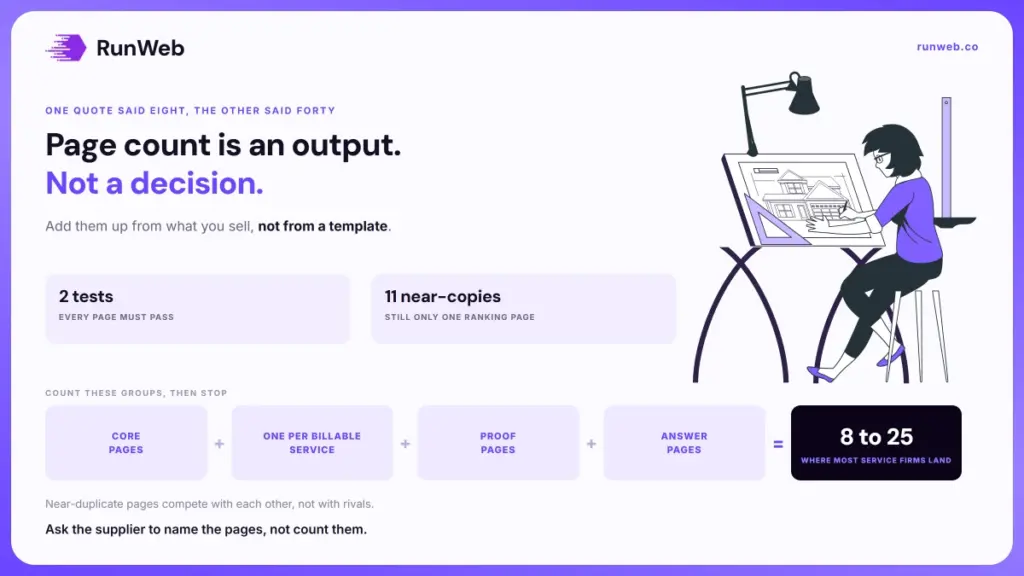
Page count is an output, not a decision. It falls out of what you sell, how many places you sell it in, and what evidence you can actually put on a page once it exists.
Which is why two quotes for the same rebuild can arrive at eight pages and forty. Neither proposal explains where its number came from, and the bigger one reads as more thorough purely because it’s bigger.
So here’s how to work the number out from your own business, why more pages routinely produce less traffic, and the point where adding another one starts costing you.
The number is an output, not a decision
The question is a bit like asking how many rooms a house should have. It depends who lives there. A single-trade business covering one town needs a fraction of what a four-service firm across three counties needs, and no benchmark can bridge that.
What makes it answerable is a rule about purpose. A page earns its existence when somebody could search for it specifically, or when it does a job no other page on the site is doing.
The two tests every page has to pass
So each candidate faces two questions before it goes on the sitemap. Could a real person type a query this page is the best answer to? And can you put something on it that no other page carries?
Fail both and it’s navigation dressed up as content. Which isn’t fatal on a contact page, since that exists to be found rather than to rank, but it does mean nobody should be billing you for it as SEO work.
A working count for a service business
Those two tests turn into a count you can do on paper in ten minutes. Work through the groups below and add them up. That total is your answer, not the number on a proposal.
| Page group | How many | Why it exists |
|---|---|---|
| Core pages | 4 to 5 | Home, about, contact, and a services hub, plus pricing where you publish it |
| One per billable service | 3 to 8 | Anything you would quote separately deserves its own page and its own phrases |
| Proof pages | 1 to 3 | Completed work, reviews and before-and-after evidence that converts the rest |
| Location pages | 0 to 6 | Only where you have jobs, reviews or photographs from that place |
| Answer pages | 3 to 10 | The questions you answer on the phone every week, written down once |
| Legal and utility | 2 to 4 | Privacy, terms, and anything a payment provider or insurer requires |
Add those up and most service businesses land between eight and twenty-five, which is why that range shows up in almost every honest quote. A firm at the top of it is usually selling several services across several areas.
Location pages are the group that tempts everybody, and the one to hold back on. Building them ahead of the work is what turns a twenty-page site into a sixty-page site carrying the same traffic. The evidence a town page has to earn is covered in local search for contractors.
Where the answer pages come from
Answer pages are the row most businesses undercount, because the material never feels like content. Every question you answer on the phone more than twice a month is a page somebody is searching for.
Keep a note by the phone for a fortnight. A list of eight recurring questions is eight pages that already have an audience, a known answer, and no research cost attached.
They also do work the service pages can’t. Somebody comparing suppliers reads them before enquiring, so they shorten the call you eventually take instead of only adding traffic.
Why more pages often means less traffic
“Thin content” gets repeated a lot without anyone explaining the mechanism. Here it is. When two pages say nearly the same thing, Google picks one to show rather than ranking both.
Its documentation on duplicate URLs describes that selection directly. So the copies never compete with your rivals. They compete with each other.
Eleven near-identical town pages produce one ranking and ten wasted briefs. The other ten still cost what they cost.
A second cost shows up later. Every page added is a page somebody has to keep accurate, and a site carrying forty that nobody has read in two years starts contradicting itself on price, coverage and hours.
The signal a site has too many
Count how many of your pages got a single visit from search last quarter. If more than half didn’t, the site is carrying weight rather than working. Merge before you publish.
The crawl budget argument you can ignore
Somebody will eventually tell you a bigger site strains Google’s crawling. For a business this size that argument doesn’t apply. Google’s guidance on crawl budget is aimed at very large sites and says plainly that most sites needn’t think about it.
So the reason to stay disciplined is editorial, not technical. Twenty pages you can keep accurate and specific will beat sixty you can’t, however often a crawler visits.
- Discovery is a separate problem: Google’s account of how Search works splits finding a page from indexing it, so a page with nothing linking to it sits unseen no matter how small the site is.
- Maintenance is the real ceiling: The honest limit is how many pages you can still keep true a year from now, and that number is lower than most people guess.
When to add a page, and when to merge two
So the site should change size over time rather than being fixed at launch. These are the triggers worth acting on, in either direction.
- Add when a service starts getting quoted separately: The moment you price something on its own, it has its own buyers and its own searches, so it has earned a page.
- Add when you can prove a location: Three completed jobs and a review from that town gives you a page nobody can accuse of being a template.
- Add when a phone question repeats: The third time you explain the same thing to a customer, write it once and link to it.
- Merge when two pages target the same query: Pick the stronger one, fold the useful content in, and redirect the weaker page rather than deleting it.
- Merge when a page has no search visits in two quarters: Either it needs the evidence it never got, or its subject belongs inside another page.
- Retire when you stop selling the service: Redirect it to the nearest thing you do sell, since the links pointing at it still carry value.
Those six turn page count into a maintenance habit rather than a launch argument. A site growing by one earned page a month ends the year stronger than one that launched with forty.
How to merge two pages without losing what they earned
Merging is the half people avoid, so it’s worth saying how it’s done. Deleting the weaker page throws away whatever links and history it built up, which achieves the opposite of what you wanted.
Move the useful sections into the surviving page first, so nothing a visitor valued disappears. Then redirect the old address, and update every internal link that pointed at it rather than leaving the redirect to do that job.
And keep a note of what you merged and when. Six months later a phrase moves, nobody remembers why, and that note is the only record of what changed.
What this means for a rebuild quote
All of which gives you something to do with those two proposals. Read the eight-page quote and the forty-page quote as claims about your business, not about how thorough the agency is.
Then ask each supplier to name the pages. Not count them. Name them.
- A list of forty with twelve town pages you can’t fill: That’s padding to justify a price, and you’ll be paying to maintain it for years.
- A list of eighteen mapped to your services and proof: That’s a plan, and you can check it against your own job book in ten minutes.
Page count drives the schedule too, because content is the phase that slips, and the redesign timeline shows how a longer list pushes that phase out by weeks. Small business website costs covers how the tiers relate to the count you settle on.
New pages also take time to earn anything, which is worth knowing before a list gets padded. How long SEO takes explains why a page published this month reports impressions rather than clicks for a while yet.
If you’d rather have the page list drawn from your services and evidence than from a template, our custom website design service starts by building it with you.
Frequently Asked Questions
Is a one-page website ever enough?
A single page can work for a business selling one service in one place, and it caps what you can rank for. Each additional service you sell is a phrase that page cannot properly own.
Do blog posts count towards the total?
Treat them separately, since the core site is a fixed structure while posts accumulate. Counting fifty posts as pages makes a small site look large and hides whether the structure is right.
Should every service have a page even if it is a small part of the work?
Give a page to anything you would quote separately and want more of. A service you tolerate rather than pursue is better placed as a section inside a related page.
What about pages for each brand you install or repair?
These work where customers search by brand and where you can say something specific about each. Where the pages would differ only by the name, one page listing the brands performs better.
How many pages before a site needs proper navigation planning?
Around fifteen, because that is the point at which a flat menu stops being readable. Grouping services under a hub keeps the depth shallow enough for both visitors and crawlers.