🎯 Key Takeaway
- How long local SEO takes depends on which of Google’s three local factors you are short on, because relevance, distance and prominence move at different speeds
- Profile edits and category fixes can register within days, since Google is reading data you control directly
- Prominence is the slow one, built from reviews and mentions that accumulate over months and cannot be scheduled
- Distance cannot be changed at all, which is why a competitor two miles closer can outrank better work
- Judge the first month on profile actions and impressions, not on map rankings, or you will cancel something that was working
Profile fixes can show up in days, and the reputation work behind them takes months.
Both get sold as local SEO, so any answer that arrives without a question first is a guess. What you are short on decides your timeline.
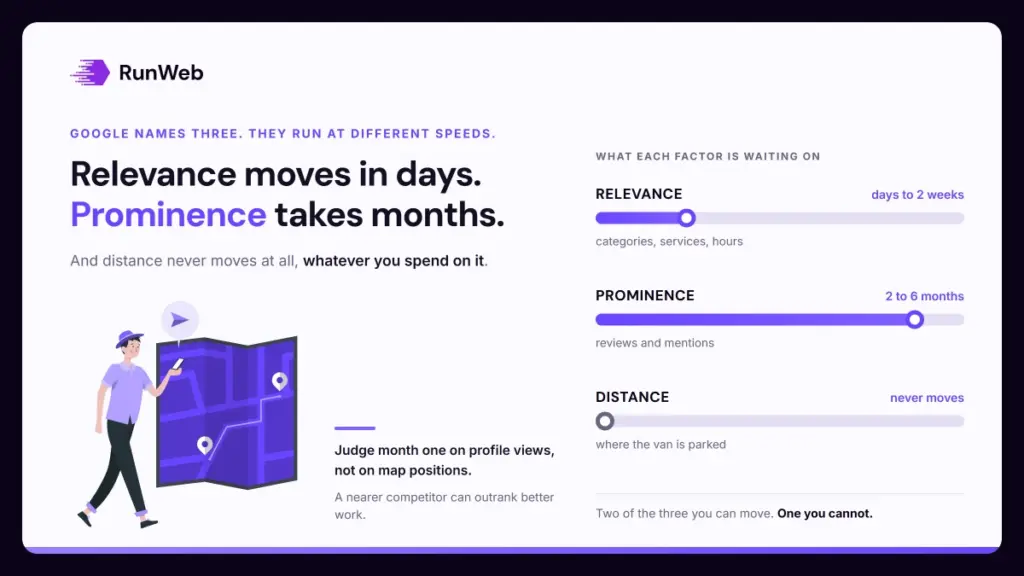
Google is unusually direct about this. It names three things that decide local ranking, and each one runs on a different clock.
So here is what each clock is waiting on, and what should have moved by week four.
The three factors, and their clocks
How long local SEO takes is really a question about which factor is holding you back. Google says local results are decided by relevance, distance and prominence, defined as how well a profile matches the search, how far the business is from the searcher, and how well known it is.
Those three behave nothing alike. Relevance is data you enter, distance is fixed geography, and prominence is other people’s behaviour over time.
So the same work lands fast for one business and slowly for another. A profile with the wrong primary category is a days problem, and a business nobody has reviewed is a months problem.
| Factor | What it depends on | First visible movement | Can you change it? |
|---|---|---|---|
| Relevance | Categories, services, hours, description, the linked page | Days to 2 weeks | Yes, directly |
| Distance | Where you are against where the searcher is | Not applicable | No, only your stated service area |
| Prominence | Reviews, mentions across the web, overall visibility | 2 to 6 months | Yes, but slowly |
| Verification status | Google confirming you represent the business | Days to a few weeks | Yes, once prompted |
| Page quality behind it | The page your profile points at | 4 to 12 weeks | Yes |
Distance is the row that explains most of the frustration. Google will rank a nearer competitor above better work, and no amount of retainer changes where your unit is.
What that means for a service area business
Serving twelve towns from one base makes distance the dominant factor in eleven of them. Your realistic aim is the towns nearest you first, and the far edge of the area through the pages and reputation rather than the map.
A map pack you cannot enter on proximity is not a failure of the SEO. It is a fact about where the van is parked.
What moves in the first month
Early work is nearly all relevance, and relevance is the fast clock. Google states plainly that complete and accurate information makes a business more likely to appear, and that verification tells it you’re authorised to represent the business.
So the first fortnight is data entry with consequences. Categories, services, hours, the description and the page your profile links to are all fields you control, and correcting them is the cheapest speed available.
Then you wait for the edits to land. Profile changes are commonly live within a few days, though anything resembling a change of identity can trigger a review that runs longer.
None of it is glamorous work.
- Week one, fix the primary category: Pick the one matching your highest-value service instead of a catch-all, because this single field does more for relevance than anything else on the profile.
- Week one, complete every field: Services, hours, description, attributes and photos, since incomplete profiles are competing with complete ones.
- Week two, resolve duplicates: Two profiles for one business split the signals, and the older one is often the one ranking.
- Week two, match the landing page: Point the profile at the page that answers the search, not the homepage, and make sure the details agree with the profile.
- Weeks three to four, start the review process: Set up the ask so prominence begins accumulating while the faster work settles.
None of those five needs a specialist. All of them need doing before anybody is entitled to judge the timeline.
Why prominence is the slow one
Prominence is how well known you are, and it’s assembled from things you influence rather than control. Reviews, mentions across the web and your general search visibility all feed it, and none of them responds to a deadline.
Reviews are the part most businesses can actually move. A steady process producing a handful a month beats a burst of twenty, because consistency is what the pattern rewards and a sudden spike invites scrutiny.
Even done well, it reads as flat for a while. Two to six months is a fair window before prominence shows up as position instead of as a slowly better looking profile.
The part that runs on your website
Prominence also leans on ordinary organic visibility, so local work and site work aren’t separable. The page behind the profile has to earn its own rankings, and that runs on the slower content clock covered in how long SEO takes.
Where you serve several towns, the structure of those pages is the constraint rather than their number, and local search for contractors covers how that gets built without producing a page per postcode.
What quietly adds weeks
Most delays are self-inflicted, and they’re boring rather than technical. Each one below is a decision that adds time without anybody deciding to add it.
- Editing the profile constantly: Frequent changes to name, address or category restart reviews and can trigger re-verification, so batch edits instead of trickling them.
- Inconsistent business details: Where your name, address and phone differ across the web, Google spends longer reconciling which version is true.
- A keyword-stuffed business name: It reads as a shortcut, risks suspension, and costs far more time than it ever buys.
- Duplicate profiles left alone: Signals split between them, and the one you are not updating often outranks the one you are.
- A slow page behind the profile: Clicks arrive and bounce, which wastes the visibility you just earned.
- Review requests in bursts: Twenty in a week then nothing for three months reads as an event, not a reputation.
Each of those is free to fix. And each one, left alone, extends every other timeline on this page.
Speed deserves a number rather than an impression. Google’s Core Web Vitals thresholds are 2.5 seconds for Largest Contentful Paint, 200 milliseconds for Interaction to Next Paint and 0.1 for Cumulative Layout Shift, and the page your profile points at should be inside all three.
What to measure at each stage
The three factors report at different times, so a single monthly ranking check tells you almost nothing. Picking the right measure for each stage is what keeps working campaigns from being cancelled in month two.
| Stage | What should be moving | If it is not, check |
|---|---|---|
| Weeks 1 to 2 | Profile edits live, verification settled | Pending review, duplicate profiles, unverified status |
| Weeks 3 to 4 | Profile views and searches rising | Primary category, missing services, thin description |
| Months 2 to 3 | Calls, direction requests and website clicks | Landing page match, page speed, weak photos |
| Months 3 to 4 | Review count and rating trending up | Whether anyone is actually asking, and how often |
| Months 4 to 6 | Map positions on core services near you | Proximity limits, and prominence against competitors |
Read that table as a diagnostic rather than a forecast. Where week four is flat, the cause is nearly always the profile itself, and where month three has views but no calls, the cause is on the page.
Those aren’t the only numbers worth keeping. Semrush’s list of local SEO metrics adds citations, review ratings and page load times to the profile data, and all three feed the slow factor rather than the fast one.
Booked work is what settles the argument, so log calls against their source and count the ones you missed. Missed calls hide real demand and make good visibility look like a failed campaign.
That last number surprises people.
When to conclude it is not working
There’s a point where patience turns into denial, and rankings are the wrong trigger for it. Positions move last, so they’re the last thing worth judging.
Stillness in the early measures is the real signal. Four months in, with the profile complete and verified, if views haven’t risen and reviews haven’t grown, another quarter buys you the same meeting.
But check proximity before concluding anything. Where every competitor above you sits physically nearer the searcher, you’re reading a distance result and no amount of work reverses it.
- Is the profile complete and verified? A supplier who cannot confirm both has not started.
- Have profile views grown since the work began? This is the earliest honest sign, and it arrives well before positions.
- How many reviews arrived, and how evenly? A flat count means the request process is not running.
- Are the businesses beating you closer to the searcher? If so, compare against businesses at your distance instead.
Where paid cover is needed while prominence builds, Local Service Ads fills the gap faster than the map will, and Yelp Ads against Google Ads covers which to fund when only one is affordable.
If you would rather start from a plan that names what moves in month one, our local SEO work opens with the audit that sets those expectations.
Frequently Asked Questions
Why does a competitor with worse reviews rank above me?
Distance usually explains it, since proximity to the searcher is one of the three factors and it outweighs a lot. Compare yourself against businesses at a similar distance before concluding the reviews are the problem.
How often should I post to the profile?
Regularly enough that the profile looks active, which for most service businesses means a couple of times a month. Frequency matters less than keeping categories, services and hours accurate.
Will more locations speed this up?
Only where you have a real staffed address at each one, because Google verifies against reality and a virtual office risks suspension. A genuine second base changes your distance for that area and nothing else does.
Do I need a website if the profile is working?
Prominence draws on your wider search visibility, and the profile has to link somewhere, so the two work together. A weak page also wastes the clicks the profile earns, which shows up as views without calls.
What if my profile gets suspended mid-campaign?
Everything pauses until it is reinstated, so treat it as the first priority rather than working around it. Suspensions usually follow a name, address or category change, which is why batching edits is worth the discipline.