🎯 Key Takeaway
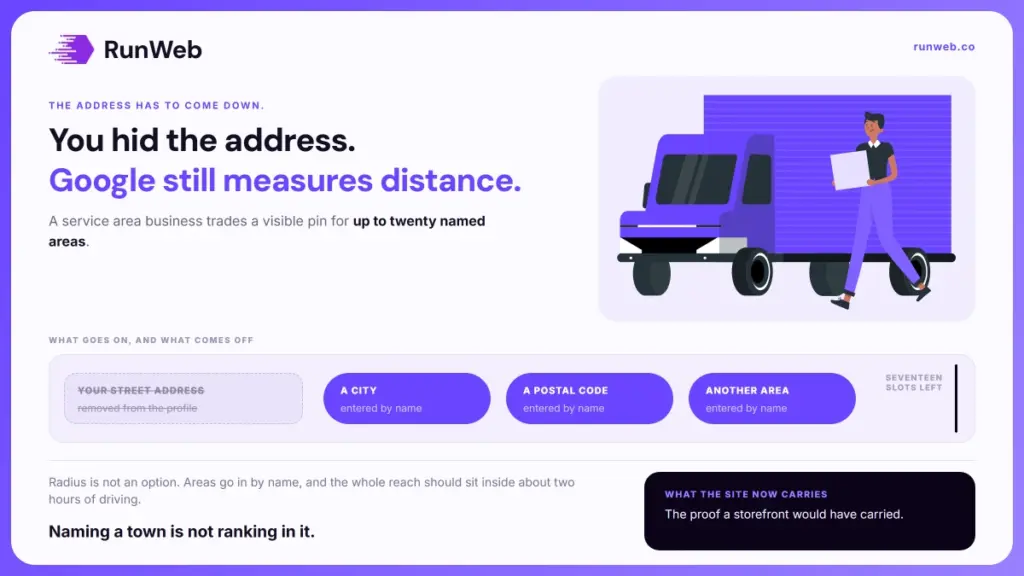
- A service area business is one that travels to the customer, and Google requires the address to come down
- Radius is not an option. Areas go in as cities, postal codes or regions, up to twenty of them
- The whole area should sit inside about two hours of driving from where the business is based
- A hidden address does not switch off distance, which stays one of three published ranking inputs
- Once the pin softens, the website carries the proof a storefront would have carried
Google does not let you keep an address where you never meet a customer.
That one rule shapes map visibility for plumbers, cleaners, electricians and every other trade run out of a van or a spare room. Take the address down and the profile changes character. Leave it up when it shouldn’t be there, and the profile can be suspended instead.
Most owners meet the rule sideways, usually while a competitor two towns over climbs above them and nobody can work out why.
So the first question is not how to rank, but whether Google already counts you as a service area business.
What makes a business one
Google’s own definition is short enough to settle most cases in a sentence. A service area business is one that visits or delivers to customers directly and does not serve them at its own address.
The test is where the work happens. Owning premises changes nothing on its own, which is why a roofing company with a yard, a lock-up and six vans still qualifies, since no homeowner ever turns up at the yard.
- You travel to the job: Plumbing, pest control, mobile grooming, carpet cleaning, appliance repair and landscaping all sit here without argument.
- You work from home: A one-person trade run from a residential address is the clearest case, since the address is a home before it is a business.
- You have premises customers never enter: A workshop, a storage unit or a yard counts as staff-only, so it does not make you a storefront.
- You do both: A tile showroom that also fits floors keeps the address and adds the areas it travels to, which Google treats as a hybrid.
And a small group of businesses is pushed the other way. Age rules beat the travel test. Google requires a storefront where the product carries an age requirement, naming alcohol, cannabis and weapons, so a mobile model is closed off there whatever the work looks like.
The address has to come down
Once you fall inside that definition, the address stops being a choice. The verb Google uses is remove. Its wording reads as an instruction and not an option, and it says that if you do not serve customers at your business address, you should take it off your Business Profile.
Plenty of owners try to route around this, and the routes are all closed. The rules on representing your business are specific about which addresses qualify, and the penalty for the rest is suspension.
| What owners try | Where Google lands |
|---|---|
| A P.O. box or a mailbox at a remote location | Not acceptable as a business address |
| A virtual office nobody sits in | Ineligible unless it is staffed during business hours |
| A desk in a co-working space | Allowed only with signage, customers received there, and your own staff on site |
| A home address left on display | Allowed if customers really are served there, and otherwise a risk |
| A relative’s address in a better town | Fails the real-world location rule, and the profile carries the consequence |
None of that is Google being difficult about paperwork. The address is what a map product sorts by, so a fake one degrades the map for everybody using it, which is why the enforcement sits at suspension instead of a warning.
Radius is not on the menu
Those rules settle where you are based. What comes next is a list. The setting that decides where Google is willing to show you does not work the way most advice says it does.
You cannot draw a radius. Areas are entered as cities, postal codes or another named type of area, and there are limits on how many and how far.
- Twenty areas is the ceiling: A profile can hold up to twenty service areas, which sounds generous until you count the towns in a county.
- Two hours is the outer edge: The whole area should not stretch beyond about two hours of driving from where the business is based.
- Edits are not instant: An approved change can take up to forty-eight hours to appear, so nobody should judge a change on the same afternoon.
- Naming a town is not ranking in it: Adding an area tells Google where you are willing to work, and it does not place you in that town’s results.
Point four is where the money gets wasted. Owners add every town within reach, see no movement, and decide the setting doesn’t work, when the setting only ever described availability.
The service area list is a statement of where you are willing to travel. It is not a list of places you have asked to rank in, and Google reads it that way.
So the same businesses reach for a page per town instead, and that route carries its own failure mode, set out under contractor SEO.
What a hidden pin costs you
That distinction matters more once you know what hiding the address actually changes. Something real is given up. Almost nobody names it before the profile goes live, and the bill arrives months later as a quiet gap in enquiries.
Semrush’s explainer on local SEO lists distance among the inputs Google weighs for map and local pack results, describing it as how far the user’s likely location sits from the business. Taking the pin off a public profile does not take you out of that calculation.
You are still measured on a distance you cannot show
So a searcher three towns away still gets sorted partly on how far away you are, while the reassurance a visible address would have given them has gone. The hidden address changed what the customer can see, and it changed nothing about what Google measures.
The two consequences pull in opposite directions.
- You reach further on paper: Twenty listed areas beat one pin for describing a real coverage map.
- You convert less on sight: A stranger comparing three profiles reads a missing address as a business that might be two counties away.
Ahrefs frames setting the service area as a basic profile step in its guide to local search, and that is fair as far as it goes. The part left out is that the step trades a piece of visible proof for coverage, and the proof has to be rebuilt somewhere else.
What the website has to carry
That somewhere else is the website. A hidden address answers none of the three questions a storefront answers before anyone thinks to ask them, and the website is the only surface you fully control once the pin comes off.
- Say plainly which towns you cover, in the same words a customer would use for them.
- Put a licence number, an insurance line and a registered trading name where a cautious person will find them.
- Show the van, the team and recent work in the areas you claim, since photographs carry geography that text cannot.
- Keep the phone number identical to the one on the profile, because a mismatch is the cheapest possible reason to be doubted.
Whether that needs one page or six is a separate question, and the counting argument sits in the page count. What doesn’t change is that the proof has to exist somewhere a stranger can reach in one click.
And when the map route stays slow, paid placement is the usual fallback for trades, which is the comparison behind Local Services Ads.
Getting it right in order
All of it goes wrong in the same place, which is doing the steps out of order. Verification punishes impatience hardest. Everything else on the profile can be changed later at no real cost.
- Verify before you hide: Complete verification while the address is still on the profile, since the process leans on a real location.
- Remove the address next: Clear it once verification is done, and expect up to two days before the change shows.
- Add areas you actually serve: Start with the towns you already have customers in, and stop well short of twenty.
- Match the name everywhere: The profile name has to be the real-world name, with no towns or services bolted on.
- Then measure: Track calls and direction requests from the profile for a full month before changing anything else.
Why the last step is the one that gets skipped
Because nothing on a profile gives instant feedback, owners tend to change three settings at once and then cannot tell which one worked. How long a fair reading takes is set out in the local SEO timeline, and the method for reading it is in checking the work.
The trade you made is the thing to keep in view. You swapped a visible address for a wider claim, and the claim only holds up if the website behind it proves you’re real, near enough and licensed. When you would rather have that site, the area pages and the profile set up as one job instead of three, that is what our websites service is built to do.
Frequently Asked Questions
Can I show my home address and still list towns I travel to?
Only where customers are really served at home. If nobody visits, Google expects the address cleared, and a hybrid setup is meant for places that do receive people.
Will a second profile for a second town work?
Duplicate profiles for one business get merged or suspended. One business gets one profile, and extra towns belong in the areas list on that single listing.
Does the van count as a location?
A vehicle is not an address and cannot be verified as one. Signwriting on it still helps recognition, though it has no bearing on what Google will accept.
How specific should the areas be?
Name real places people search for, which usually means towns and postal districts. Inventing a regional label nobody types leaves the entry doing nothing at all.
What happens if I move house?
Update the base address even though it stays private, since the two-hour reach is measured from it. Leaving the old one in place quietly distorts where you are shown.