🎯 Key Takeaway
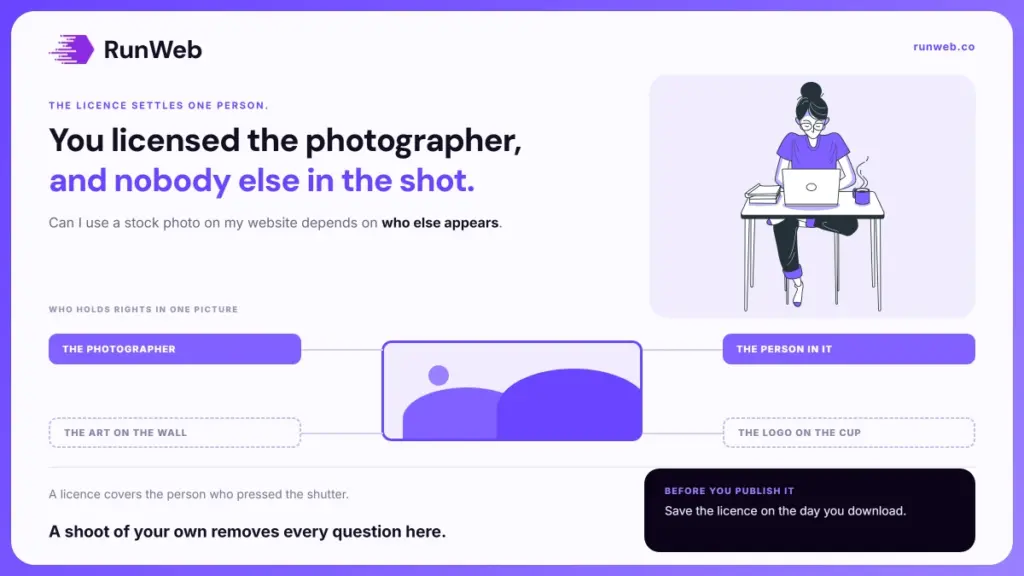
- Asking can I use a stock photo on my website has two answers, because a licence covers the photographer and nobody else in the picture
- Free libraries issue a licence too, and that licence carries conditions you agree to by downloading
- Recognisable people, logos and branded products in a shot need separate permission for advertising use
- Copyright exists the moment a photograph is taken, with no notice or registration needed
- Keep the licence record at download time, because proving your right later is the part nobody plans for
A licence is permission with edges.
Most owners picture the question as a single gate. Pay for the photograph and you may use it, take it without paying and you may not. That version is right about the money and wrong about the edges, and the edges are where an unexpected invoice comes from.
What a stock licence settles is one thing only, which is the photographer’s claim over the image. Everything else in the frame keeps its own rights, and those belong to other people.
So the useful question is not whether you paid, but where the file came from.
What a licence actually buys
Photographs are protected the instant they exist. The US Copyright Office states that a work is under protection “the moment it is created and fixed in a tangible form”, which means no notice, no symbol and no registration are needed for the photographer to hold rights in it. A picture with nothing written on it is not a picture that is free to take.
Because protection is automatic, what you are buying is never the photograph itself. You are buying a defined permission to use it, and the definition is the part that varies.
| Where the file came from | What you are relying on | Where it usually goes wrong |
|---|---|---|
| A paid stock library | The licence attached to that download | Using it outside the uses the licence lists |
| A free library | A published licence with conditions | Reading free as unconditional |
| A design tool’s built-in library | That tool’s own content terms | Exporting the image out on its own |
| A search engine results page | Nothing at all | Assuming the search result is the source |
| Your designer’s account | A licence issued to them | Keeping the image after they leave |
Row five is the one that catches established businesses. A licence is issued to whoever downloaded the file, so images bought under an agency account stay tied to that account when the relationship ends, exactly like the other assets covered in the package tiers.
Free is a licence as well
That table puts paid and free side by side on purpose. Free libraries do not hand out images without terms. They issue a licence like everybody else, and downloading is how you accept it.
Unsplash is the clearest example, because its terms are short enough to read in full. The Unsplash licence grants you the right to copy, modify and use its images for free, including commercially, without asking permission and without crediting anyone. Two conditions sit alongside that grant.
- You cannot sell the image itself: The licence bars selling images without significant modification, so a photograph is not stock you can resell.
- You cannot rebuild the library: Compiling images to replicate a similar or competing service is out.
- Design tools add their own rule: Built-in libraries generally allow the image inside a design and not as a standalone export, which is a different test from the one you just passed.
- Free tiers can differ from paid tiers: Within one tool, the free and premium pools often carry separate terms and separate assurances.
Condition three is where small businesses trip. A photograph pulled out of a design tool and uploaded straight to a page as a hero image has left the design it was licensed inside, and nothing about the file itself signals that.
The people and brands in the frame
None of those conditions is the one that produces real trouble. Every licence discussed so far settles the photographer’s rights, and a photograph frequently contains other people’s property too.
Unsplash says this plainly on its own releases page, and the wording is worth having exactly. Contributors agree their uploads have model releases, but the company states there is “no reasonable way for us to monitor all images” and that it “cannot make any guarantees about the scope of permitted uses”.
Objects that appear in the image may have copyright or trademark protection that prohibit use of the image without permission, for example a person wearing a t-shirt with a brand logo on it.
Three categories carry rights of their own, and all three turn up in the sort of photograph a service business reaches for.
- Recognisable people: They hold rights over commercial use of their likeness, so a smiling face on a page selling your service is the highest-risk use of all.
- Logos and branded products: A laptop badge or a printed cup in shot belongs to a trademark owner, and advertising is where that starts to matter.
- Buildings and private property: Some need a property release, which is a separate document from a model release.
- Artwork inside the photo: A mural or a poster on the wall behind your subject has its own copyright holder.
The first of those deserves a moment, because advertising is exactly what a website does. A photograph used editorially on a blog post sits in a gentler position than the same photograph placed beside a price and a booking button.
Where Google Images fits
That brings the answer round to the search results page, since that is where most of these files are found. A results page indexes images hosted elsewhere, so it is never the source and it grants nothing.
Google says so itself. Its guidance on finding reusable images opens by warning that images “might be subject to copyright”, then explains the usage rights filter for narrowing results to licensed material.
- Filter, then verify: The filter reflects information supplied by the hosting site, so Google advises confirming the licence details at the source.
- Follow the link through: The image detail panel points at the page hosting the file, which is where any terms actually live.
- Treat a missing licence as a no: An image with no stated terms is not an image with permissive terms.
- Screenshots are images too: A cropped screenshot of somebody’s photograph is the same photograph.
Point one is the whole of it. And the filter is worth using, provided you read it as a shortlist to check rather than a clearance to act on.
If a letter arrives about an image
Once you know where the files came from, the letter that sometimes follows is easier to handle. Image owners and the agencies acting for them do send demands, often years after a page went live, and the first instinct is usually the wrong one.
Because copyright arises automatically, not knowing is not a defence. What it does affect is scale, and the Copyright Office is explicit that registration is a precondition of suing over a US work and of recovering statutory damages and legal fees.
- Do not delete it and say nothing: Removal is sensible and it does not undo the past use, which is what the claim is about.
- Find your own record first: A download receipt or a licence reference ends most of these in one reply.
- Check who actually sent it: Some demands come from recovery agencies on commission, and some are simply invented.
- Take advice before paying: The opening figure in these letters is a request, not a judgment.
Point two decides almost all of them. Where the image came from a library under your own account, the trail already exists and the answer is a lookup rather than an argument.
The record worth keeping
That record is the thing worth building deliberately, and it costs a few seconds per image at the moment you download. Nobody keeps it, because at download time there is no problem to solve.
- Where it came from: The library name and the image reference or page address.
- Which account downloaded it: Yours, or a supplier’s, since that decides whether it survives a change of supplier.
- What the licence allowed: A copy of the terms as they read on the day, because terms are revised.
- Where you used it: The pages carrying it, which is what makes a later clean-up a task rather than a hunt.
The moment to run this in bulk
A rebuild is when the whole library passes through your hands at once, so the audit is close to free then and expensive at any other time. Add it beside the other pre-launch checks in the redesign checklist, and decide at the same time which pages need a photograph at all, which is the sort of question how many pages you need settles.
And the strongest answer to all of it is to own the pictures outright. A short shoot of your own team, your own van and your own finished work removes every question on this page at once, alongside the account housekeeping in domain privacy. When you would rather that was handled as part of the build, that is what our websites service covers.
Frequently Asked Questions
Do I have to credit the photographer?
Paid libraries rarely require it and some free ones do, so the terms on the download decide. Crediting where it is not required costs nothing and helps if the source is ever questioned.
Can I crop or edit the picture?
Most licences allow modification, and a few restrict changes that put a subject in a false light. Editing never converts a restricted use into a permitted one.
Is an image safe to use if it has no watermark?
A missing watermark says nothing about rights, since protection needs no marking at all. Plenty of protected photographs circulate with nothing on the face of them.
What about pictures my designer supplied?
Ask which account they were licensed under and get that in writing. Files licensed to a supplier travel with the supplier unless the licence says otherwise.
Does one purchase cover print and social too?
Coverage depends on the licence tier, and website use often sits in a narrower band than print runs or paid advertising. Read the listed uses before reusing a web image on a flyer.