🎯 Key Takeaway
- Ask can I use music on my website and the honest answer starts by splitting the track in two
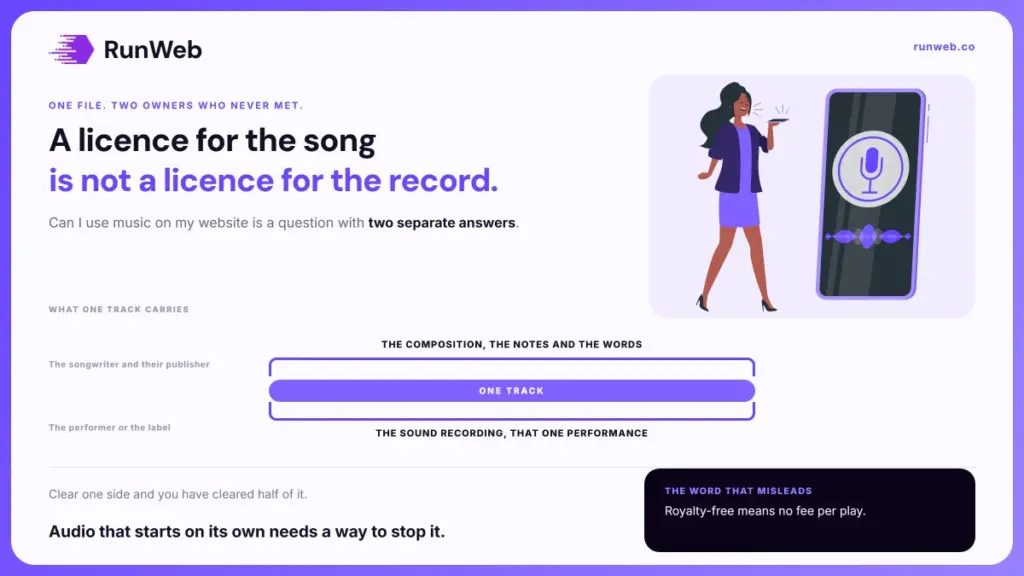
- A song and a recording of that song are separate works with separate owners
- Royalty-free describes how you pay rather than whether you pay, and the licence still sets the limits
- Music supplied inside a platform or a design tool is governed by that tool’s own licence document
- Audio that starts on its own for more than three seconds needs a way to stop it
One track. Two owners, and neither of them has met the other.
Most pages answering this question treat music as a single permission you either have or lack. That framing is where people come unstuck, because a recorded song is two protected works stacked on top of each other, and a licence for one of them says nothing about the other.
Get that split right and the rest of the question becomes ordinary admin. Get it wrong and a paid licence can still leave you exposed.
So start with what you are actually licensing.
Why one track is two works
Play a song and you are hearing two creative acts that the law treats separately. Somebody wrote it, and somebody else performed and recorded it. Copyright attaches to each of those independently, which is why a cover version exists at all.
The statute spells the second half out. Its definitions describe a sound recording as a work resulting from the fixation of a series of musical, spoken or other sounds, which is a different thing from the arrangement of notes and words being performed.
| The work | Who usually holds it | What it governs |
|---|---|---|
| The composition | The songwriter and their publisher | The notes and the words, in any performance |
| The sound recording | The performer or the label that paid for the session | That one captured performance |
| A cover you record yourself | You hold the recording, not the composition | Still needs the songwriter’s side cleared |
| A track from a library | The library, acting for both | Both sides at once, on the terms in the licence |
That fourth row is why libraries exist and why people use them. Clearing two owners for one background loop is an afternoon of email that nobody running a plumbing company has, and a library that controls both sides sells the whole permission in a single document. That is what you are paying for.
And the rights involved are broader than copying. The Copyright Office lists the exclusive rights an owner holds, and they include performing the work publicly, with a separate entry covering public performance of a sound recording by digital audio transmission. A website streaming audio to visitors is closer to that description than most owners expect.
What royalty-free actually means
Once you start shopping for a library track, the phrase you meet everywhere is royalty-free, and it is the most misread term in the whole subject. It describes the payment structure. It doesn’t describe the price, and it certainly doesn’t mean unrestricted.
Royalty-free means you are not billed per play. You still buy a licence, and that licence still names what you may do with the track and for how long.
Reading the licence takes ten minutes and the four things worth finding are always in there somewhere.
- The permitted use: some licences cover video only, some cover a website, and the two are not assumed to be the same.
- The term: perpetual, or a subscription that ends, in which case what happens to work already published matters more than the monthly fee.
- Attribution: whether a credit is required, and where it has to appear.
- Transferability: whether the licence belongs to you or to the agency that bought it, which is the one clients discover late.
Transferability is worth a second look if somebody else built the site. A licence bought under a designer’s account can leave with the designer, and the track on your home page then has no paperwork behind it. That’s the same question as who owns what across the domain, the hosting and the imagery.
Where a platform’s library stops
That question of scope gets sharper with the free libraries built into tools you already use. They’re useful, and they’re also written for the place they live in.
Take the best documented example. Google describes the Audio Library as royalty-free production music and sound effects found inside YouTube Studio, for use in your videos, and it offers two licence types.
- The Creative Commons option: you must credit the artist in the video description, which is a requirement written around a video description rather than a web page.
- The standard library licence: no attribution required, and the terms still sit in Google’s own document rather than in a general rule.
- What follows for a website: read the licence for the use you actually have, because a permission written for one surface is evidence about that surface.
- The same applies to design tools: a template with a soundtrack attached comes with a content licence, and that licence is the only thing that answers the question.
Point three is the discipline worth keeping. Nobody can tell you what a given library allows without reading its licence, and any page that tells you otherwise is describing a document it has not opened.
Where the licence is unclear, treat that as an answer rather than an inconvenience. Ambiguous paperwork on a free asset is a poor trade against a track that costs a few dollars and comes with terms written in plain words.
The rule that applies even when you own it
Having cleared both copyrights, one constraint is still waiting, and it holds even for music you wrote and recorded yourself. Accessibility guidance treats sound that starts without being asked for as a barrier rather than a flourish.
If any audio on a web page plays automatically for more than 3 seconds, either a mechanism is available to pause or stop the audio, or a mechanism is available to control audio volume independently from the overall system volume level.
That is success criterion 1.4.2, and it sits at Level A, the lowest of the three conformance levels. The reasoning given is practical rather than aesthetic.
- Screen readers get drowned out: somebody listening to your page cannot hear the speech output over a soundtrack.
- The controls become unreachable: a visitor who cannot hear the reader cannot find the button that stops the noise.
- Three seconds is the threshold: a short sound effect sits outside it, and a looping background track does not.
- The volume slider on the device is not the mechanism: the criterion asks for control of that audio, separately from the system level.
Most sites resolve it by not autoplaying at all, which costs nothing and sidesteps the whole criterion. A visible play button hands the decision to the visitor. Those who want the music will press it.
Settling it on your own site
None of that produces a universal answer, since the right call depends on the site and on who built it. The sequence below settles it in an afternoon.
- Name the track and the source: if nobody can say where a file came from, that’s the finding.
- Find the licence document: not the marketing page, the licence, and save a copy with the invoice.
- Check it covers a website: the commonest gap is a licence written for video being used on a page.
- Check whose name is on it: yours, or a contractor’s, which is the difference between owning the permission and borrowing it.
- Turn autoplay off: or add a control that pauses the audio, and test it without a mouse.
Where music earns its place, and where it does not
Background audio on a service business home page rarely survives contact with a visitor who is comparing three firms with three tabs open. A studio, a venue, a music teacher or a restaurant is a different case, because the sound is the product being sold, and even then the play button belongs to the visitor.
So decide it as a content question first and a licensing question second. A page that would be weaker without a soundtrack is worth the paperwork, and a page that merely feels emptier without one is better served by the attention going into how many pages the site really needs.
And if a site already carries audio that nobody can trace, the fix belongs in the next scheduled pass rather than on a Friday afternoon, alongside the rest of ongoing maintenance and whatever else lands on the redesign timeline. That is the kind of thing we settle at build time on the sites we build.
Frequently Asked Questions
Can I play a radio stream in my shop’s waiting area?
Premises are a separate question from a web page and are usually handled through a business music supplier. Ask the supplier what their agreement covers, since a domestic subscription rarely extends to a commercial space.
What happens if I use a track without permission?
The usual first contact is a takedown notice or a demand letter from an agent acting for the owner. Replacing the file quickly and keeping the correspondence is the sensible response.
Does a short clip count as fair use?
Length is only one factor and a short excerpt is not automatically safe. Decorative background use on a commercial site is a weak position, whatever the duration.
Can I use a song if I credit the artist?
Crediting somebody is not the same as being permitted by them. A credit satisfies a licence that asks for one, and on its own it changes nothing.
Is AI-generated music safer to use?
The tool’s terms decide what you may do with the output, so read those before assuming anything. Ownership of machine-made material is unsettled, which cuts both ways when somebody else reuses it.