🎯 Key Takeaway
- Whether can I use a company logo on my website has a yes depends on why the logo is there
- Naming a company accurately is treated differently from displaying its mark in a way that implies endorsement
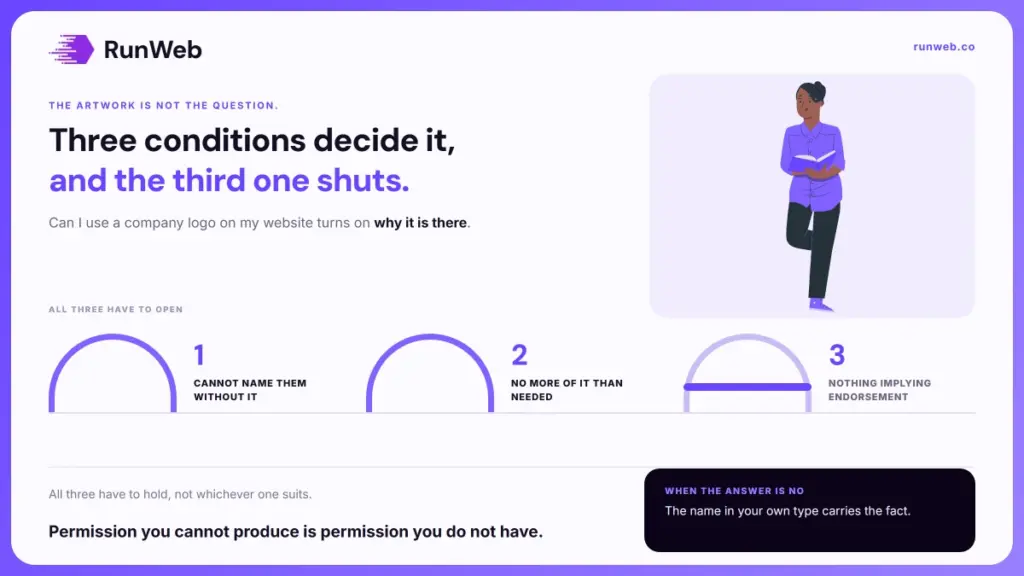
- Three conditions decide it, and the third one is where most logo walls fail
- A logo can be protected as a trademark and as artwork at once, so redrawing it does not help
- Where permission is refused, the company name set in your own type carries the same information
The rule changes with the reason you are using it.
Logos land on small business websites for ordinary reasons. A wall of client logos. The badge of a review site sitting beside your phone number. Every one of them is somebody else’s trademark, placed on a page that sells something.
What decides the answer is not whether you credited them or linked to them. It is why the mark is on the page at all, because identifying a company accurately sits in a different position from using its mark to borrow its standing.
So the useful first question is what the logo is doing there.
What a trademark actually protects
A trademark is narrower than people assume. The US Patent and Trademark Office defines one as any word, phrase, symbol or design that identifies your goods or services, and it spends a paragraph correcting the belief that owning a mark means owning the word.
Those rights attach to how a word or design is used with particular goods or services, in the office’s own explanation of a trademark, and not to the word in general. That is why the question is never simply whether the logo belongs to someone else.
| What you want to put on the page | What protects it | Where the difficulty sits |
|---|---|---|
| The company name, set in your own type | Trademark only | Very little, where you are naming them accurately |
| The logo artwork itself | Trademark, and often copyright as well | Reproducing the drawing is a second permission |
| A slogan or tagline | Trademark, not copyright | Using it as though it were your line |
| A screenshot of their product | Copyright in what the screen shows | Republishing their material as your own |
Row two is the one people get wrong. The Copyright Office states plainly that copyright does not protect names, titles, slogans or short phrases, while noting that logo artwork may carry copyright where it contains sufficient authorship, and that an artistic logo may also be protected as a trademark.
Two regimes over one object. And redrawing the mark by hand escapes neither of them, because a close imitation is exactly what trademark law is built to catch.
The three conditions that decide it
Once both regimes are on the table, the practical test is easier than the law sounds. Using somebody’s mark to refer to them has a recognised name, and that name comes with conditions anybody can apply.
Those conditions come from the trademark profession itself. The International Trademark Association publishes the three conditions that have to hold together, and all three do rather than whichever one suits.
- The thing cannot be identified without the mark: Where you could say what you mean without it, the case weakens immediately.
- You use no more of the mark than you need: The name in text is less than the logo, and the logo is less than the logo in their brand colours at the top of your page.
- Nothing about the use suggests endorsement: The use must not imply sponsorship or approval by the owner.
Condition three is where a logo wall usually fails, and it fails quietly. A row of marks under a heading like “trusted by” is doing work that a plain list of names would not do, and the work it is doing is exactly the impression condition three rules out.
The client logo wall
That is the section most readers came for, so it is worth being direct about it. A wall of client logos is the commonest trademark question a service business has, and it is also the one where permission is easiest to get.
And most clients say yes. The awkwardness is not usually legal, since a company that liked your work has an ordinary interest in being seen next to it.
- Check the contract first: Many service agreements already carry a clause covering whether either side may name the other publicly.
- Watch for the opposite clause: Some contracts forbid it outright, and confidentiality terms are commoner in finance, health and public sector work.
- Permission is per use, not forever: Approval for a case study is not approval for an advertisement.
- Former clients are the risk: A wall nobody has revisited in three years is usually the one carrying a company that has since left.
The last point is the one to act on today, because it costs nothing and it is the failure a reader can actually check. Walls go stale. Where a logo has sat on your page since a job that finished long ago, the permission it rests on may have expired with the relationship, in the same way the licences behind using a stock photo travel with whoever bought them.
Badges, card marks and social icons
Those same three conditions answer the smaller marks too, and they answer most of them favourably. Platforms that want to be displayed generally publish the artwork themselves, and publishing it is the permission.
So the distinction worth holding is between a mark you were given and a mark you took.
- Badges the platform supplies: Review sites and directories hand out embed code precisely so you will use it, and the terms come with the code.
- Card marks at a checkout: Payment networks publish artwork for merchants, and the permission is tied to actually accepting that card, which is part of setting up payments on your website.
- Social icons in a footer: Linking to your own profile is identifying a destination, which sits comfortably inside condition one.
- A platform’s logo as a trust signal: Placing a well-known mark near a claim about yourself is a different act, and it is the one that strays into condition three.
Point four is the line between the two groups. Displaying a review platform’s badge because you have reviews there is fine, and displaying it because it looks reassuring beside your prices borrows somebody’s standing instead. The reviews behind the badge are what carry the weight, which is the argument in how many reviews you need.
Asking, and what to ask for
Once a use sits outside those comfortable cases, asking is cheaper than deciding for yourself. Larger companies have a page for it, and the request is routine rather than adversarial.
Permission you cannot produce is permission you do not have. A verbal yes from somebody who has since left the company is the commonest version of this, and it fails at exactly the moment it is needed.
What you ask for matters as much as asking, since a vague yes creates a second argument later.
- Name the placement: The page it appears on, and whether it sits in advertising.
- Name the period: An open-ended permission is fine when it says so in writing.
- Ask for their file: Brand teams would rather supply the artwork than watch a stretched copy circulate.
- Keep it where the contract lives: An email in one person’s inbox is not a record the business holds.
The third one turns the conversation around. Asking a brand team for their own logo file reads as respect for their work rather than as a legal enquiry, and it usually produces both the file and the yes in one reply.
When the answer is no
Sometimes that answer is no, and sometimes nobody replies at all. The fact survives without the picture. Neither outcome leaves you stuck, because the information you wanted to convey was never really in the artwork.
- Use the name, set in your own type: Naming a company accurately carries the fact, and it is the smallest possible use of the mark.
- Describe the work instead: A sentence about what you built for a regional accountancy firm says more than a logo ever did.
- Use a quote with a name attached: A named person at a named company is stronger proof than a mark.
- Count instead of naming: Serving fourteen firms in one trade is a claim you own outright.
The version that works better anyway
Option four is worth trying even where permission was granted, because a wall of unfamiliar marks asks a visitor to recognise companies they have never heard of. A plain sentence about who you serve and what changed for them does the job without depending on anyone else’s brand, which is the same reasoning behind keeping the page count honest in how many pages you need.
And if you would rather the proof on your site was built from your own work rather than borrowed from other people’s marks, that is how we approach it in our websites service.
Frequently Asked Questions
Does linking to their site change anything?
A link makes the reference clearer and it grants nothing by itself. Attribution and permission are separate things, and the first does not produce the second.
Can I show a mark inside a case study?
Editorial context sits more comfortably than advertising, though the same three conditions still apply. Written approval from the company remains the thing that settles it.
What if the company has been acquired?
Permission usually travels with the brand to its new owner, and the contact who granted it will not. Re-confirm with whoever runs the brand now before a rebrand strands you.
Do I need permission for a screenshot of their product?
Screenshots carry copyright in whatever the screen shows, which is separate from the trademark question. Many software companies permit screenshots explicitly in their brand terms.
Is a supplier badge treated differently?
Certification and partner marks come with rules from whoever issued them, usually tied to holding a current status. Letting the certification lapse while the mark stays up is the common fault.