🎯 Key Takeaway
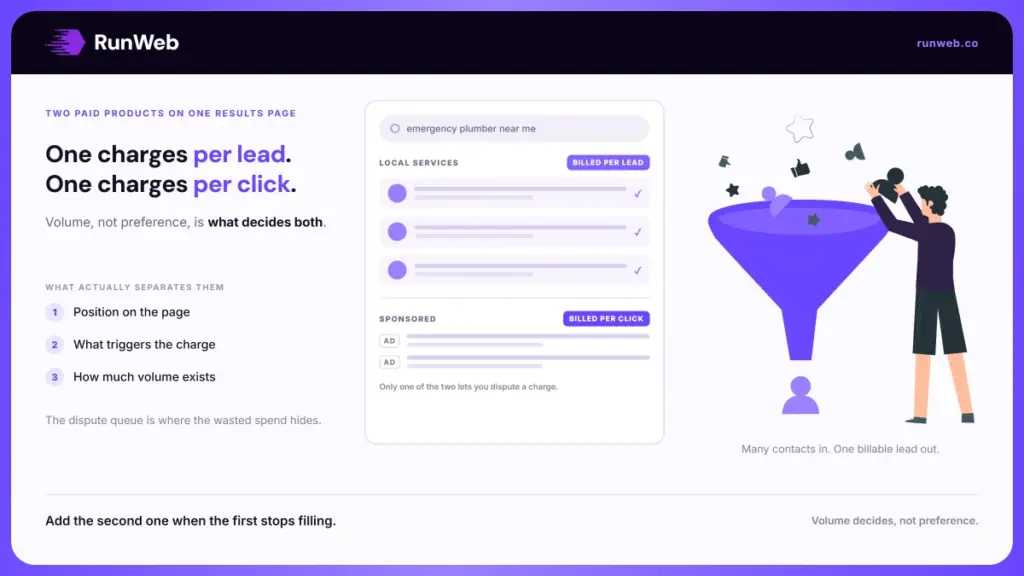
- Local Service Ads vs Google Ads compares a pay-per-lead product with a pay-per-click one, so the two are priced on different events
- Local Service Ads sit above the paid search results and need licence and insurance checks before they run
- Google Ads need a landing page, and they can target work that no Local Services category covers
- Volume is the usual reason to run both, because Local Service Ads are capped by demand in your category and area
- Dispute the bad leads, since an unchallenged wrong-number charge is the commonest waste in the product
One of these products bills you when somebody rings. The other bills you when somebody clicks. They sit on the same results page, they come from the same company, and Google’s own sales calls rarely make the difference clear.
So the confusion is fair enough. In a screenshot the two look almost identical, and underneath they behave nothing alike.
Here’s where each one sits on the page, what it charges for, what it wants from you before it’ll run at all, and the point where running both stops being duplication and starts being the obvious move.
Where each one sits on the page
Both formats fire on the same search, and that shared trigger is what makes them look interchangeable. But their position on the page differs, and position explains most of why the numbers come out so far apart.
Local Service Ads take the block right at the top, above the ordinary paid results, showing a business name, a rating, a review count and a call button. Google’s introduction to Local Services Ads covers how that placement and the screening behind it work in the US.
Google Ads sit underneath, as a headline and two lines of text pointing at your website. So a searcher meets your Local Service Ad as a shortlisted supplier, and your Google Ad as a link worth a look.
Why that ordering matters more than the creative
The top block absorbs the first glance. A Google Ad in the same auction is therefore competing for attention that’s already been spent, which doesn’t make it worthless, because plenty of people scroll and compare before they call anyone.
What it does mean is that you shouldn’t judge the two on click-through rate against each other. They’re being seen at different moments, by a searcher in a different state of mind.
What you are charged for
Placement pairs with billing, and this is where most comparisons go wrong. Local Service Ads charge you for a lead, meaning a call or a message. Google Ads charge you for a click, whether or not anything comes of it.
On the Google side you pay the actual cost per click, which is often below your maximum bid. Your daily budget behaves as an average rather than a ceiling, and the monthly total is capped near thirty times it.
| What you are comparing | Local Service Ads | Google Ads |
|---|---|---|
| Position on the page | Top block, above paid search | Below the Local Services block |
| Billed on | A call or message received | A click on the ad |
| Where the enquiry lands | Your phone, through Google | A page on your website |
| Before it can run | Licence, insurance and background checks | A working landing page |
| Targeting control | Category and service area only | Keywords, match types, schedules, audiences |
| Available volume | Capped by demand in your category and area | Limited mainly by budget |
| Bad enquiries | Disputable, and refundable when upheld | Absorbed as wasted click cost |
| Data you keep | Lead log inside the Local Services account | Analytics, audiences and conversion history |
Two rows in that table decide most budgets. Available volume is the first, because a business that has saturated Local Service Ads in its area can’t buy more work there at any price.
Local Service Ads are the only one of the two where a wrong number, or a job well outside your area, can be handed back for a credit. Nobody does it weekly. That’s most of why the product has a reputation for expensive junk.
How to compare a lead price with a click price
One product bills on contact, the other on curiosity, so you can’t set their headline numbers side by side. A thirty dollar lead and a six dollar click describe different events, and the click still has to survive your landing page before it becomes either.
Convert both into cost per booked job. Take each channel’s spend for the period, divide by the jobs it actually put on the calendar, then ignore every other figure the dashboards offer you.
That sum surprises people in both directions. Local Service Ads look expensive per lead and frequently win on booked jobs. Search campaigns look cheap per click and give most of that advantage back on a page nobody built to convert.
What each product demands before it runs
Those billing models carry different entry costs, and not all of them are financial. Local Service Ads won’t switch on at all until Google has verified who you are.
- Licence and insurance evidence: Trade licences and liability cover have to be uploaded and checked, which takes days rather than minutes and stalls where a certificate has lapsed.
- Background screening: Owner and sometimes employee checks apply in many categories, so the timeline includes a third party you cannot chase.
- A consistent business identity: Google’s guidelines for representing your business govern the name and address used, and a mismatch between your profile and your licence is a common reason for a stalled application.
- Review collection through Google: The rating shown in the block comes from your Google reviews, which means the ad’s persuasiveness is decided before the campaign starts.
Google Ads asks for none of that. What it asks for instead is a page that can carry the reassurance the Local Services block hands over for free, which means a tappable number, a service area written out in words, and reviews sitting on the page rather than linked away from it.
What Local Service Ads cannot do
With a placement advantage like that, why run the other product at all? Because Local Service Ads are deliberately narrow, and plenty of demand falls outside them.
Those categories are fixed. Work that doesn’t map onto one of Google’s service types has nowhere to sit, so a business selling emergency repair and a maintenance subscription can advertise the first and not the second.
And the targeting is coarse. You pick a category and a service area, and that’s more or less it. Google Ads lets you bid differently on “emergency” than on “quote”, schedule spend around the hours somebody actually answers the phone, and run a separate campaign for whichever service carries the best margin.
Where Google Ads earns its place
So it becomes the tool for everything the categories miss. Commercial contracts. Specific brands or equipment you install. Services with a long decision cycle, and any campaign where you want the visitor on your own site, leaving behind data you keep.
Some trades still pull real volume from review platforms as well, which is covered separately in Yelp Ads.
When running both is the right answer
All of that points at a sequence rather than a choice, and volume decides where you sit in it. Local Service Ads are usually the better first purchase, because the enquiry arrives as a phone call and you only pay when it does.
- Start with Local Service Ads if you qualify: Paying per lead removes the landing-page dependency, which matters when the website is not ready to carry paid traffic yet.
- Raise the weekly budget until it stops filling: Every category and area has a ceiling, and you have found it when extra budget stops producing extra calls.
- Add Google Ads at that ceiling: This is the point where the second product is buying incremental work rather than duplicating the first.
- Split by intent, not by budget: Give Local Service Ads the core emergency category and let Google Ads take the services and phrasings no category covers.
- Compare on cost per booked job: A lead price and a click price cannot be compared directly, so divide each channel’s spend by the jobs it actually booked.
- Review the split quarterly: Category demand shifts with season and with how many competitors have finished their own verification.
Those six steps also settle the argument the sales call started. Which product is better was never the question. It depends entirely on whether your category still has unclaimed demand sitting in it.
What the split looks like once it settles
In most home service accounts the sequence ends lopsided rather than even. Local Service Ads take the bulk of the budget for the core emergency category, because that’s where pay-per-lead works hardest and where the verification has already been done.
Google Ads carry a smaller share aimed at what the categories can’t reach. That share shifts with the season, since a category saturated in July may have room in February.
Review it quarterly. Getting the split right first time matters less than noticing when a competitor finishes their own verification and takes volume you were counting on, because nothing will alert you when that happens.
The part most businesses skip
Whichever way the split lands, one habit separates the businesses that get value out of Local Service Ads from the ones that quietly overpay. They dispute the bad leads, every week, as a job somebody owns.
A wrong number can be reported and credited back. So can a call for work you don’t offer, or a job two hours outside your area. Left alone for a quarter, those add up to a real number.
- Put it in one person’s diary: Fifteen minutes a week beats an annual clear-out, because the reporting window is not indefinite.
- Log the reason, not just the dispute: A pattern of out-of-area calls usually means the service area is drawn too wide.
Neither product replaces unpaid visibility either. That review count in the top block comes from the same profile work covered in local search for contractors, and how fast that side pays back is in how long SEO takes.
That budget question also shapes which one you start with. If you’re still working out what a site capable of carrying paid clicks costs, small business website costs sets out the tiers.
And if you’d rather have the split decided on your own numbers than on a sales call, our Google Ads management service starts by working out which of the two your category can still fill.
Frequently Asked Questions
Do the two products compete against each other in the auction?
They occupy separate blocks and separate auctions, so one does not raise the other’s price. What they can share is a searcher, which is why measuring both on booked jobs matters more than measuring either on clicks.
Is the Google Guaranteed badge worth the verification effort?
The badge is what the top block trades on, and businesses that have it report better call rates than the same listing without it. Allow several weeks for licence and background checks before expecting any spend.
What happens when a category is unavailable in your area?
Where no category matches your trade, Local Service Ads cannot run at all and search campaigns become the only paid route. Coverage widens over time, so a category unavailable last year is worth rechecking.
Can you control which hours the calls arrive?
Both let you set hours, though only search campaigns let you bid differently by time of day. Turning off spend outside answering hours is the single cheapest improvement available to either product.
How many disputed leads is normal?
A small percentage of any lead flow will be misdials or out-of-area enquiries, and treating the dispute queue as a weekly task keeps that cost near zero. Left alone for a quarter, it becomes a real number.