🎯 Key Takeaway
- Small business website packages differ far less in design than in discovery, copy, tracking and testing, which is why two sites can look alike and perform nothing alike
- Published build ranges run from a few hundred dollars for a self-built site to five figures for agency work, so a tier label tells you almost nothing on its own
- Price rises with decisions made for you: what to say, who to say it to, and how you will know it worked
- The cheap package is expensive when it produces rework, and the costly one is wasted when nobody will maintain it
- Compare packages on ownership, tracking, exclusions and revision rounds, because those four are where the real differences hide
The quotes come back at wildly different numbers for what sounds like the same job.
All three describe a modern, mobile-friendly site. All three show work you would be happy to put your name to. And none of them explains why one costs several times the other.
The gap is real, and it’s almost never about how the site looks. It sits in how many decisions the price includes, and how much of the risk moves off your desk.
So here’s what actually changes as the number goes up, and how to tell which parts you need.
What the price is really buying
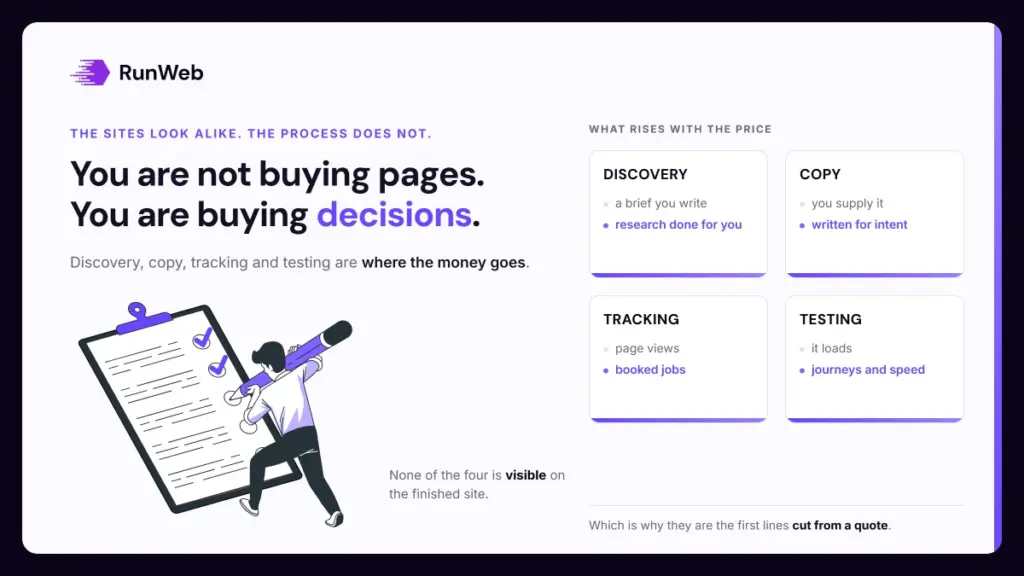
Small business website packages are priced on decisions, not on pages. A cheap package hands the decisions back to you, and a costly one absorbs them.
Those decisions are things like what your main offer should be, which three services deserve their own page, what proof will convince a nervous buyer, and what counts as a conversion worth tracking. Every one of them has to be made by somebody.
When the package doesn’t include them, you make them. That’s fine if you know your market and have the time, and it’s where cheap builds quietly go wrong when you don’t.
Why the sites still look similar
Modern templates are good, so the visual gap between tiers has narrowed to almost nothing. What hasn’t narrowed is whether anyone worked out what the page should say.
Two sites can share a template and a colour palette, and one of them converts at three times the other because somebody wrote the headline on purpose.
So a portfolio tells you very little. Ask instead what the process produces before anyone opens a design tool.
What the published ranges look like
Public figures for a small business build spread very wide. HubSpot puts a do-it-yourself route at a few hundred dollars and full agency builds far higher, with annual upkeep running from $400 to $60,000 depending on what the site does.
Both ends of that are honest. The bottom is a template you configure yourself on shared hosting, and the top is a large build with integrations and a team maintaining it.
Because the range is that wide, a tier name is not a specification. What follows is the ladder underneath the labels, which is the part that stays true whoever is quoting.
| What you are buying | Entry package | Mid package | Upper package |
|---|---|---|---|
| Discovery | A brief you write | A call and a short audit | Research into buyers and competitors |
| Copy | You supply it | Editing of what you supply | Written to search and conversion intent |
| Structure | Template pages | Service pages with a lead path | Service and area structure, planned internally |
| Tracking | Basic analytics | Form and call events | Events tied to booked work, not clicks |
| Testing | It loads | Cross-device checks | Performance and end-to-end journey testing |
| Revisions | One round | Two rounds | Rounds plus a post-launch window |
Read that table downwards rather than across. Each column is the same site with more of the thinking bought in, and the row that matters most to you depends on which of those you cannot do yourself.
The four things that separate tiers
Four items account for most of the price difference between packages. None of them is visible on the finished site, which is exactly why they get cut first when a quote needs to come down.
- Discovery time: Hours spent working out who buys from you and what stops them. Cut it and the site describes your company instead of answering your customer.
- Copy: Whether somebody writes the pages or you do. Supplied copy is the single most common reason a build stalls for weeks.
- Tracking: Whether you can tell which page produced a booked job. Without it every later decision about the site is a guess.
- Testing: Cross-device checks, form journeys and speed. Faults here are invisible until they cost you a lead nobody knows about.
Each of those has a cheap substitute, and the substitutes are fine in the right circumstances. You write the copy because you know the trade better than any writer will, or you skip deep discovery because twenty years of customer conversations are already in your head.
What goes wrong is substituting silently. A package that quietly excludes copy doesn’t tell you it has moved a fortnight of work onto your evenings.
Where speed belongs in this
Performance is a testing line, not a design one, and it has published targets you can hold anyone to. Google’s Core Web Vitals set 2.5 seconds for Largest Contentful Paint, 200 milliseconds for Interaction to Next Paint and 0.1 for Cumulative Layout Shift.
Ask which the package tests against, and on which pages. A quote promising fast without a threshold has promised nothing.
What the lead path is worth
Structure shows up in the same place. Semrush’s guidance on landing page optimization notes that pages generally perform better when they focus on one primary action and limit unnecessary navigation, which is a scoping decision made long before anything is designed.
That’s the difference between a services page and a page that asks for the job. Upper tiers buy the second one.
When the cheap package is the expensive one
A low quote turns costly through rework, and rework has a predictable shape. The site launches, it does not produce enquiries, and the fix is a second project rather than a tweak.
But the reverse trap is just as common. An expensive build with nobody to maintain it decays into an asset that cannot be edited, and then the cost lands as a rebuild two years early.
- You cannot edit it yourself: Every text change becomes a ticket, so the site stops reflecting what you actually sell.
- The copy was never written: Placeholder text ships, and the pages describe services in the words of whoever built it.
- No tracking was configured: Six months later nobody can say which pages produced work, so the next budget is set blind.
- Ownership sits with the agency: Domain, hosting or analytics registered elsewhere turns leaving into a negotiation.
- The structure will not extend: Adding a fourth service means rebuilding the navigation, which is a scoping failure rather than a design one.
Each of those is avoidable at quote stage for the price of a question. And each one costs more to fix after launch than it would have cost to include.
Working out what the site has to earn
Any package is affordable or not against one number, which is the margin on the work it brings in. Revenue is the wrong measure here, and using it is how website spending gets justified badly.
Take a build at $4,000 with $200 a month of hosting and upkeep. Year one costs $4,000 plus twelve months at $200, so $6,400 in total.
Then apply margin. If a typical job bills $2,500 and your gross margin is 35%, each job contributes $875, so the site needs about eight jobs in its first year to cover itself.
Eight jobs is a question your diary can answer. A percentage return calculated on revenue is a question nobody can.
Once you have that figure, the tier choice gets easier. Where eight jobs looks trivial against your current volume, buying discovery and tracking is cheap insurance, and where it looks like a stretch, the entry package plus your own copy is the honest answer.
Build cost and running cost belong in the same sum, which is why small business website cost and website maintenance cost are two halves of one budget.
Questions that make two quotes comparable
Bring the same questions to every conversation and the quotes stop being guesses. Most of these take a supplier under a minute to answer, and hesitation on any of them is itself information.
- Who writes the copy? The answer moves roughly two weeks of work between you and them.
- What is excluded? Exclusions turn into invoices, so get them named while you are still choosing.
- How many revision rounds, and what counts as one? A round is a batch of feedback, not a single change, and the definition should be written down.
- Whose name is on the domain, hosting and analytics? Yours, or leaving gets expensive.
- What tracking is configured, and for which actions? Calls and forms at minimum, tied to something you would call a lead.
- Can I edit page text without help? Ask for a demonstration on the actual system.
- What happens after launch? A fix window of a few weeks is normal, and its absence should be priced in.
- Which performance targets are tested, and where? Named thresholds on named pages.
Those eight also expose the difference between a package and a proposal. A package answers them the same way for everyone, while a proposal answers them about your business.
Page count comes up in every one of these conversations too, and how many pages settles it before it turns into a pricing argument. If a rebuild is what you’re really scoping, the redesign timeline covers what that adds.
When you would rather have the scope written against your business than picked off a tier list, our website design quotes are built that way.
Frequently Asked Questions
Is a template site worse than a custom one?
Templates are not the weak point in most cheap builds, since the same template can carry an excellent site. What separates them is whether anyone did the thinking about structure, copy and tracking on top of it.
How many pages should be in the package?
Enough for one page per service you actually want enquiries about, plus the usual home, about and contact. Padding a package with extra pages adds maintenance and rarely adds enquiries.
Should I pay more for copywriting?
Pay for it if writing has stalled other projects of yours, because supplied copy is the most common cause of a build running late. Write it yourself if you know the trade well and will actually sit down to it.
What is a fair number of revision rounds?
Two rounds suits most small builds, provided a round is defined as a collected batch of feedback. Unlimited rounds without a turnaround time is a worse deal than two rounds with one.
Can I upgrade a package later?
Usually, though it depends on how the first build was structured. Ask before you buy whether adding services or locations later means extending the site or rebuilding the navigation.