🎯 Key Takeaway
- A google maps seo company sells work on your profile, your reviews and your site, and Google says a better local ranking cannot be requested or paid for at all
- Any provider who guarantees a map position is either misunderstanding the product or hoping you will not check
- Judge the engagement on what arrives in the first thirty days, since that is the only part you can verify early
- Profile accuracy, categories and review handling are the pieces most owners can keep in house without help
- The riskiest work is the profile edit that breaks Google’s own guidelines, because the penalty for that is suspension
Most of what a Google Maps SEO company sells is real work, and none of it is a ranking.
But the pitch usually arrives the other way round, with a position promised up front and the actual work left vague. The order matters. That reversal is what makes the category so hard to buy sensibly.
So the honest way to judge a provider is by what lands in the first month, because that part you can check against a list.
Below is what the work consists of, what Google says nobody can sell you, and which pieces you could keep for yourself.
What cannot be bought at any price
Google publishes how it orders local results, and it also publishes the limit. On its page about local ranking on Google it states plainly that there’s no way to request or pay for a better local ranking on Google.
That single line does more vetting work than any question you could invent. Read it twice. Because if position cannot be bought, then a provider promising position is selling something they do not control.
What can be bought is the work that makes a profile more accurate, more complete and better reviewed than it was last month.
Why the distinction is not pedantry
The work and the outcome move on different clocks, and they can come apart for a whole quarter. A profile can improve while the ranking sits still, usually because a competitor improved faster or the searcher was simply standing somewhere else.
Distance is the clearest example, since it’s a property of the person searching rather than anything on your profile. So the same business ranks differently for two customers on opposite sides of one town, and no amount of spend changes that.
Which signals move and how slowly is covered in how long local SEO takes, and it is worth reading before signing anything monthly.
What the work actually consists of
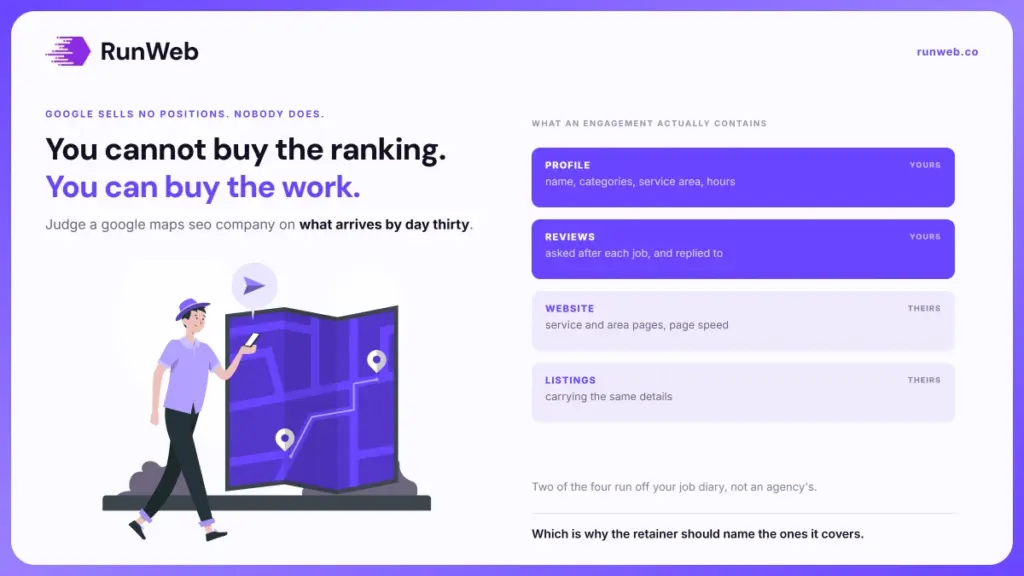
Strip out the reporting and the calls, and a map visibility engagement is four workstreams. Ask anyway. Every provider does some mix of them, though almost none will break the retainer down this way unless pushed.
Ahrefs’ survey data in its guide to local SEO puts the profile first, reporting that 36% of SEOs think your Google Business Profile is the most important ranking factor for the map pack, with 17% naming reviews instead.
| Workstream | What it involves | Who usually should own it |
|---|---|---|
| Profile accuracy | Name, categories, service area, hours, services list | You, with one review by a specialist |
| Review programme | Asking after each job, replying, handling the bad ones | You, because it runs off your job diary |
| Website signals | Service and area pages, contact details, page speed | Whoever can edit the site |
| Off-site consistency | Directory listings carrying the same details | A provider, since it is dull and repetitive |
The third column is the real question. Two of those four run off things only you have, which are the customer conversations and the job calendar, so paying a retainer for them tends to buy chasing rather than expertise.
The parts you can keep in house
Before quoting the work out, it’s worth knowing which pieces need no specialist at all. Start there. Four of them take an afternoon each, and then a few minutes a week after that.
- Get the categories right: Google asks you to use as few categories as possible and to pick ones completing the sentence “this business is a”, not “has a”.
- Fix the details that stop a call: HubSpot’s roundup of local search behaviour cites research that 63% of consumers said incorrect business details would stop them using a local business.
- Ask for a review after every completed job: A short link sent the same afternoon outperforms any campaign run later, and nobody outside your team can send it.
- Reply to the reviews you have: Replies are visible to the next reader, so they do work whether or not they move a ranking.
Once those four are running, what remains really is specialist work. That is a far smaller purchase than the one most owners get quoted for. And the same split applies to organic search, where SEO for contractors covers which parts a trades business can hold itself.
What the first month should produce
A first month that produces a report and nothing else is the common failure. That distinction matters by month five. What it should produce is a set of artefacts you still own if you walk away.
- A written baseline: Current profile state, review count and rating, and the enquiry volume you started from, all dated.
- An access list: Who now holds the profile, the site and the analytics, with your own account as the primary owner on all three.
- A completed profile audit: Every field either filled or explicitly declined, including the services list most profiles leave empty.
- A named review routine: Who asks, at what point in the job, and through which link, written down rather than promised on a call.
- A change log: What was edited and on which date, so a later ranking movement can be traced to something real.
That last one is the item providers resist most, and it’s the one worth insisting on. Without a dated change log, month six is a conversation about feelings rather than a comparison of before and after.
Whether the site itself is ready to take the extra visibility is a separate question, and page count settles most of it.
Promises that should end the conversation
Some claims are not merely optimistic. They describe either an impossibility or a policy breach you would carry the risk for.
The edits that can get a profile suspended
Google’s rules on representing your business are specific about the name field, ruling out marketing taglines and store codes, and asking for the name as consistently represented in the real world across signage and stationery. It also reserves the right to suspend access to Business Profiles for guideline breaches.
- Keywords added to your business name: The single most common breach, sold as a quick win, and the one most likely to cost you the profile.
- A guaranteed position or a top-three promise: Ruled out by Google’s own wording, so the guarantee is either ignorance or a bet on you not checking.
- A virtual office to widen the map pin: Google requires a precise address or service area and asks for permanent signage at the address, and it does not accept a P.O. box.
- A service area drawn across a whole state: Google’s guidance is that the area should not extend farther than about two hours of driving time from your base.
- Categories chosen as keywords: Explicitly warned against, since categories are meant to describe the core business rather than carry search terms.
Each of those transfers a risk to you while the provider keeps the fee. Do not negotiate that one. So the right response is a different provider rather than a better price.
Questions to ask before you sign
Bring the same six questions to every conversation and the quotes become comparable. Time them if you like. None of them takes long to answer, and hesitation is itself an answer.
- Whose Google account owns the profile? Yours, as primary owner, or leaving turns into a recovery process.
- What will you have changed by day thirty? Named edits with dates, rather than an audit and a plan.
- How will calls be attributed? If nothing counts calls today, the first month’s job is measurement rather than optimisation.
- What is excluded from the retainer? Website edits are the usual exclusion, and they are usually where the work actually is.
- Which of the four workstreams are you doing? Ask them to pick from profile, reviews, website and listings, and to say which they are leaving to you.
- What would make you tell me to stop paying? A provider with no answer has never planned for the engagement to end.
Those six also separate a package from a proposal, since a package answers them identically for every customer. Where the answers cover several channels at once, the ordering problem in a small budget matters more than the provider you choose, and auditing the work covers how to hold anyone to it.
When you would rather the profile work, the site and the reporting were quoted as one scope against your own numbers, our SEO packages are built that way.
Frequently Asked Questions
Is a specialist provider needed if my listing already appears?
Appearing and being chosen are different states, and most profiles that appear are still missing the services list, photos and recent reviews. Fill those first, then decide whether anything is left worth paying for.
Do paid Google ads improve my organic map position?
Advertising and the free listing are separate systems, so spending on one does not lift the other. Ads can sit above the map results, which changes how much traffic the listing receives without changing its order.
How many directory listings do I actually need?
Consistency across a modest number beats volume across hundreds, and the survey data suggests their weight has fallen over the last decade. Get the largest few carrying identical details, then stop.
Can two people at one trading address both be listed?
Separate profiles need separately distinguishable businesses, with their own name, category and staffing, or the pair risks being merged. Sharing an address alone is not the deciding factor.
What happens to the work if I cancel the retainer?
Profile edits, reviews and page changes stay in place, since they live on assets you own. What stops is the maintenance, so the listings drift back out of step as details change.