🎯 Key Takeaway
- Asking do I need a website for my business has a real answer of no for a small group, and yes for everyone else
- A Google Business Profile is free, shows in Search and Maps, and asks you for a website address during setup
- Referral-fed businesses with no growth plan and no hiring are the clearest case for waiting
- The profile controls the box. It never controls what a stranger reads after they tap it
- When the answer turns to yes, one page has to exist before the rest are worth building
Some businesses really don’t need a website yet.
Most web companies won’t say that out loud, which is a reason to say it. A firm that fills its diary on referrals and turns work away every week isn’t being held back by a missing site.
But the group that applies to is smaller than it looks, and it shrinks the moment anything changes. A single retirement in a referral network can reverse the position inside one season, and so can one competitor who quietly adds a booking form.
So the useful question is which side of that line your business sits on today.
The short answer
You need one when a stranger has to decide about you without meeting you. That is the entire test. It explains why two businesses of identical size land on opposite answers, and why arguing about industries never settles anything.
A commercial plumber working three contracts a year for the same property managers has no strangers in the pipeline. A domestic plumber taking calls from people who found them ten minutes ago has almost nothing else.
- Every customer arrives warm: A word-of-mouth business is being vouched for by somebody the customer already trusts.
- Every customer arrives cold: Search, maps and ads all deliver people who know nothing and are comparing three names.
- Most businesses run a mix: And the mix moves, usually without anyone noticing until a quiet month arrives.
So the answer follows the pipeline. Counting where last month’s enquiries actually originated settles the question faster than any comparison between industries.
What a profile already does
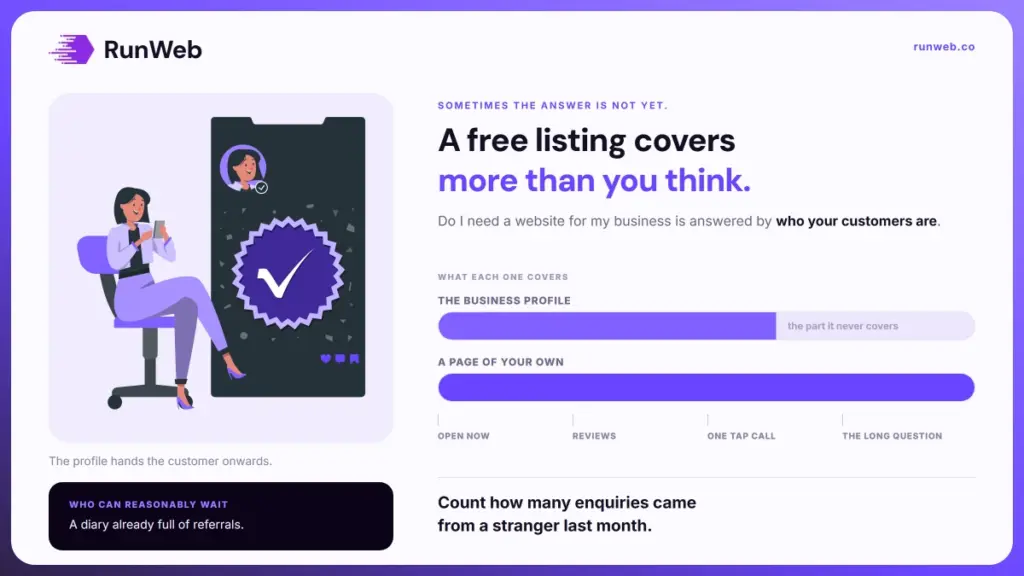
That count usually turns up a free listing doing more work than expected. A Google Business Profile is a free tool for managing how a business appears in Google Search and Google Maps, and for many trades it is the first thing a new customer ever sees.
It covers a surprising amount. Owners who feel guilty about having no website are frequently looking at a listing that already handles the questions customers ask first.
| What a customer wants | The profile handles it |
|---|---|
| Are you open right now | Yes, with hours and holiday hours |
| What do other people say | Yes, reviews sit right there |
| Can I call you | Yes, one tap |
| Where are you, or where do you go | Yes, a pin or a list of areas served |
| What exactly do you do, and for whom | Partly, in a short description nobody reads twice |
| Can I see the work, the prices, the process | No |
And the setup flow itself gives the game away. Partway through creating a profile Google asks for a phone number and a website address, then asks whether you deliver or work on site so you can enter the areas you serve.
Where the profile stops
That website field is the seam. The profile is built to hand a customer onwards, and if there is nowhere to hand them, the journey ends in a box you do not control.
- You cannot answer a long question: Anything needing more than a sentence, like scope, warranty, finance or lead times, has no home on a listing.
- You cannot be found for what you do: Search visibility beyond the map runs on pages, and how Google finds pages depends on crawlable links pointing at them.
- You cannot capture anyone out of hours: A call button is the only path, so every enquiry after six o’clock either rings out or goes elsewhere.
- You cannot change the rules: Layout, fields, categories and what shows first are all Google’s decisions, and they move without notice.
- You cannot take it with you: The profile is a listing on somebody else’s product, and a suspension takes the whole shopfront down at once.
Point five is the one owners dismiss until it happens to somebody they know. Suspensions arrive without warning. And they arrive for administrative reasons, like an address edit or a category that no longer matches the licence.
Who can reasonably wait
None of that makes waiting wrong. HubSpot sets out five reasons not to build one, and what stands out is that none of them is money.
The four that hold up for a small business
Three of the five travel well to a trade or service business, and one needs a caveat.
- You are not trying to grow: If the goal is a steady week and a full diary, finding more customers is not the problem to solve.
- Referrals already cover you: An established network of clients and introducers is doing the job a website would be hired to do.
- You are not hiring: Candidates research an employer before applying, so recruitment quietly becomes a reason once you need people.
- You are close to a monopoly: A specialism with no local alternative changes the maths, though this is rarer than owners believe.
The fifth reason on HubSpot’s list is about selling the business, which matters less day to day and lands hard exactly once. A buyer valuing your firm will ask what happens to the enquiry flow when the founder leaves, and a referral network is an answer that walks out with you.
Every reason to wait is a statement about today. None of them is a statement about next year, and that is why the list keeps expiring on people.
What waiting actually costs
Those reasons expire quietly. Nothing breaks on the day the answer changes, and no notification arrives to mark it, which is exactly what makes the cost so difficult to see.
The bill shows up as work you never hear about. A customer compares three names, finds two with pages showing the job they need doing and one with a phone number, and quietly stops considering the third.
Because that decision happens without contact, nothing in your own records ever registers it. Enquiry counts look stable, referrals keep arriving, and the businesses winning the comparisons are winning them somewhere you cannot observe.
The same invisibility applies to price. A customer who cannot see the shape of what you sell assumes the cheapest quote is comparable to yours, so the conversation starts on cost and never reaches the reasons your quote is higher.
- Paid traffic has nowhere sensible to land, which is the whole argument in landing page vs website.
- Map visibility gets harder to improve once the profile is the only asset, as set out in map visibility.
- Search takes months to build from a standing start, and how long SEO takes is measured in quarters.
Point three is the one that decides the timing. Because the work takes a season to show, the right moment to start is a season before you need it, which is always earlier than it feels.
If the answer is yes
Once that timing argument lands, the next mistake is building everything simultaneously. Sequence beats completeness here. A single page answering the customer’s immediate question outperforms a hurried five-page site carrying a full navigation menu.
- One page that sells the main job: The service you most want more of, written for somebody who has never met you.
- Proof a stranger can check: Photographs of finished work, a licence number, insurance, and the towns you cover.
- Two ways to make contact: A phone number that works on a tap and a form that works at eleven at night.
- The profile pointed at it: Put the address in the website field so the free listing starts feeding the page.
- Then the rest: Extra services, an about page and anything else can follow once the first page is earning.
What it costs to keep running
Because the ongoing bill worries people more than the build, both halves are worth knowing before you start. What a build runs to is broken out in what a website costs, what changes between tiers sits in package tiers, and the monthly side is in care plan costs.
None of that changes the original test. Count how many of last month’s enquiries arrived from somebody who had never previously heard of you, and let that number decide. When it says yes and you would rather have the page, the proof and the profile set up as one job, that is what our websites service does.
Frequently Asked Questions
Can a Facebook or Instagram page do the job instead?
For reach, sometimes. For a stranger checking whether you are real and insured, a social page buries that under posts, and you are renting the audience on terms that change.
Is one page enough to start with?
For most trades, entirely. One well-built page for the service you want more of will outperform five thin ones, and you can add the rest as demand shows you what is missing.
How quickly can a small site go live?
Days, once the copy and photographs exist. Waiting is almost always caused by gathering content, never by the build, so start collecting job photos now.
Will I have to keep writing blog posts?
Nothing obliges you to. Publishing helps search visibility over time, though a business winning on maps and referrals can leave the site as a stable set of service pages.
What if I already paid for a builder subscription?
Use it until it limits you. The usual limits arrive as slow pages, thin templates and no way to move the site elsewhere, and that is the point to reconsider.