🎯 Key Takeaway
- The landing page vs website question is settled by where the visitor came from, not by which one is better
- A website serves several audiences with several goals, while a landing page serves one visitor with one
- Google treats the page an ad points at as one of three inputs into your ad quality, so the choice has a price
- Sending paid clicks to a homepage makes the visitor do the sorting you were paid to do for them
- Most small businesses need both, and the website is the one to build first
Nobody asks this question until they are about to spend money.
It arrives the week somebody sets up their first campaign and reaches the field marked final URL. The field is blank. It wants one address, and there are two reasonable candidates sitting on the same site.
Both are right, for different visitors. A page that works beautifully for a stranger arriving cold performs badly for someone who clicked an ad about one specific job.
So the useful version of the question is not which is better, but which one this particular click should land on.
What each one is for
Both words describe a job rather than a template, which is why the definitions people argue about keep talking past each other.
Semrush defines the narrower one tightly in its explainer on landing pages: a webpage designed to drive one action. It goes on to say plainly that a homepage is not one, because a homepage usually serves multiple audiences and carries multiple goals.
HubSpot puts the same distinction in terms of what gets removed, describing a landing page in its best practice guide as a standalone page with one clear purpose that strips away the menus and sidebars a normal page carries.
| A website | A landing page | |
|---|---|---|
| Who arrives | Anyone, from anywhere, at any stage | One audience, from one source, with one question |
| How many goals | Several, and they compete | One, and everything serves it |
| Navigation | Full, because exploring is the point | Trimmed, because leaving is the risk |
| How long it lives | Years, edited in place | As long as the campaign behind it |
| What it is judged on | Whether people find what they came for | Whether they do the one thing |
And that last row is the whole difference. One is judged on breadth and the other on a single number, so the same design choice can be right on one and wrong on the other.
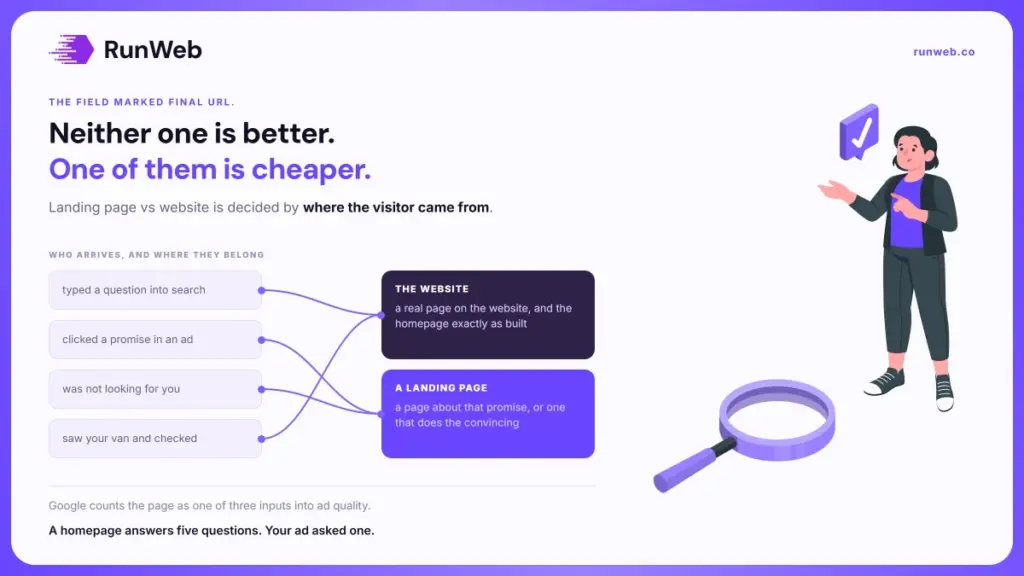
The traffic source decides
Those two jobs map onto where the visitor came from, which is why the question cannot be answered in the abstract. What somebody already knows when they arrive is the whole input.
- Organic search: They typed a question and chose you from a list, so they are still comparing. Send them to a real page on the website.
- A paid search ad: They read a specific promise and clicked it, so anything that is not that promise is friction.
- A social ad: They were not looking for you at all, so the page has to do the convincing the search never did.
- A recommendation or a van: They already trust you and want to check you are real. The homepage is exactly right.
Two of the four do not want a stripped-down page at all. They want the site, and building a campaign page for them removes the context they arrived to find.
So the rule that survives contact with a real business is narrow. Paid clicks with one promise attached get a page built around that promise, and everything else gets the website.
Why Google puts a price on the answer
That rule holds even if you disagree with it on taste, because for paid search the destination is not only a conversion question. It is priced.
Google’s documentation on Quality Score names landing page experience as one of its three components, alongside expected clickthrough rate and ad relevance. It defines the component as how relevant and useful your landing page is to people who click your ad.
The page is not judged after the click, as a separate exercise in conversion. It is one of the inputs deciding what the click cost in the first place.
And Google’s own advice on improving it is less mechanical than people expect. It asks you to give people what they are looking for, keep the ad and the page consistent, load quickly and work on a phone. The word-for-word search phrase does not need to appear.
Where it stops being a suggestion
Separately from quality, there are rules. Google’s destination requirements say an ad has to accurately reflect which site the user is being directed to, and it lists a display URL whose domain does not match the final URL as a mismatch.
It also disallows destinations that fail to function, return an error to Google’s crawler, or cannot be reached from the location you are targeting. So a landing page hosted somewhere other than your main site is a legitimate choice with a condition attached, and the condition is that the domain still has to line up.
The homepage trap
Those rules explain why the default choice is the expensive one. When nobody decides, the final URL gets the homepage, and a homepage is the worst possible destination for a click somebody paid for.
- It answers a question they did not ask: They searched for one job and arrived at a page introducing the whole company.
- It offers them exits: Every menu item is a way out, and you just paid for the way in.
- It makes them sort: The visitor now has to find the relevant service themselves, which is work you were paid to do.
- It reads as inconsistent: The ad said one thing and the page says five, which is exactly the consistency Google asks about.
And none of that means the homepage is badly built. A homepage serving several audiences at once is doing its job correctly, which is precisely why it makes a poor destination for a visitor who arrived with one question already formed.
The same mistake shows up on social campaigns, where the boost button quietly picks a destination for you. That decision and its consequences are covered in boosting against campaigns.
What a landing page drops
Once the case for a dedicated page is clear, the harder question is how far to strip it. Most templates overdo it.
Semrush is careful about that trade. Minimising navigation keeps visitors focused on the action, and the same guidance says to keep access to necessary links such as privacy policies and terms, plus limited brand navigation, so the page does not frustrate people.
- Drop the full menu: Every service you do not sell on this page is a distraction from the one you do.
- Drop the second offer: Two calls to action compete, and the weaker one wins more often than you would like.
- Keep the proof: Reviews, licence numbers, insurance and the service area all belong, since a stranger needs them more than a returning visitor does.
- Keep a way to check you are real: A phone number, an address and a link to the main site, which is also what the destination rules expect.
The version most small businesses actually need
For a business running one or two campaigns, a full separate page system is overkill. A well-built service page on the existing site, pointed at directly instead of through the homepage, does most of the work and costs nothing extra to maintain.
Whether you already have enough of those pages is a question answered in the page count, and the tier differences that decide whether campaign pages are included at all sit in the package comparison.
Which one to build first
So the order matters more than the choice does. One of the two is a prerequisite and the other is an optimisation, which settles the sequence for almost every small business.
- Build the website first: It is where organic visitors, referrals and anyone checking you out will arrive, and it works without a budget attached.
- Point ads at a real service page: Before building anything new, send the campaign to the page that already matches the promise.
- Measure what arrives: Without conversion tracking, the comparison between the two destinations is opinion.
- Then build a dedicated page: Once one campaign spends enough to justify it, and only for that campaign.
Step three is the one that gets skipped, and it makes the other three unfalsifiable. Getting the measurement in place first is the same problem set out in checking the work, and it applies to paid traffic just as directly.
Where the wider question is how much of one budget should go to each channel before any of this matters, that comparison sits in splitting a small budget, and what an agency charges to run the campaigns is in management fees.
When you would rather have the site, the campaign pages and the tracking built as one thing rather than three, that is how our websites service is set up.
Frequently Asked Questions
Can a landing page hurt my search rankings?
A thin page built only for ads earns little organically, though it rarely damages anything else. Keep it out of your sitemap if it duplicates a service page you already rank with.
Do I need a separate tool to build one?
Not usually. Most site platforms let you publish a page with the navigation switched off, which avoids paying a second subscription and keeps everything on one domain.
How many should a small business have?
One per campaign that spends real money, and none for campaigns that do not. Building a page for every keyword produces a pile of near-identical pages nobody maintains.
Should the phone number be on it?
For any trade or service business, prominently and more than once. A form-only page quietly filters out the customers who wanted to speak to somebody today.
What about traffic from an email or a social post?
Treat it like a paid click, since the reader arrived with a single specific expectation. Point them at whichever page delivers what the message promised.