🎯 Key Takeaway
- Google ads for contractors usually fails on settings rather than on keywords or budget
- The location option Google recommends also reaches people who are merely interested in your area, which is not the same as being in it
- Call-only ads are being retired, so phone leads have to come through call assets instead
- Most wasted spend in a trade account goes on people researching a repair they intend to do themselves
- Running ads outside the hours somebody answers the phone pays for calls nobody takes
Ask a contractor how their Google Ads went and you get one of two answers.
Either it brought work in steadily, or it burned through a few thousand and produced tyre-kickers from three counties away. The gap between those outcomes is rarely the budget.
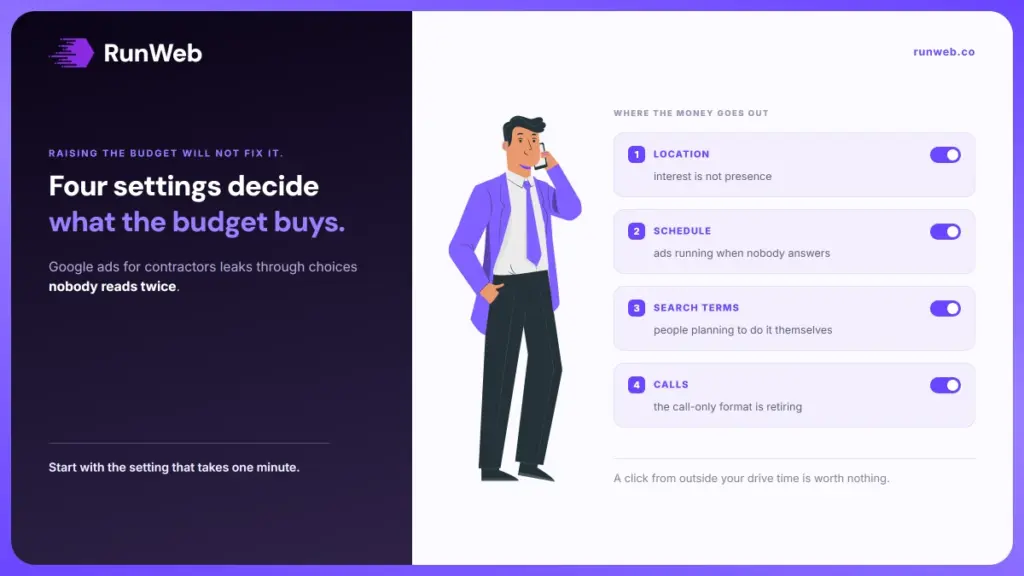
It is almost always four settings, and none of them is the one owners worry about.
So here is what each of the four does and which one to change first.
Why a trade is a different advertiser
Most Google Ads advice is written for a business that sells the same thing to anyone, anywhere, at any hour. A trade does none of those things.
- Your market has a hard edge: Beyond a certain drive time the job stops being worth doing, and a click from outside that edge is worth nothing at all.
- Your best lead is a phone call: Somebody with water coming through a ceiling is not filling in a form and waiting.
- Your demand spikes: One cold snap or one storm moves a month of searches into a weekend.
- Half your searchers want to avoid you: The person typing how to fix a leaking tap is not a customer, and they click anyway.
Each of those four maps onto a setting, which is the useful way to read the rest of this. Semrush’s explainer on how PPC works lists what the auction weighs, and it includes the context of the search itself: device, location, time of day and the terms used.
So the auction is already reading three of your four constraints. The settings decide whether it reads them the way you meant.
The location setting that spends your money
That edge around your market is the first thing to get right, and it is also the one most accounts get wrong by accepting a recommendation without reading it.
Google’s documentation on location targeting describes two broad options. The recommended one for Search campaigns reaches people “who not only exist in your targeted locations, but have shown an interest in your targeted locations”.
Interest is not presence. Somebody two states away reading about roofing costs in your town can see your ad, click it, and cost you the same as a homeowner three streets from your yard.
For a business that ships nationally, that breadth is the point. For a business that drives a van, it is a slow leak that looks like poor conversion.
The radius problem nobody warns you about
Google lists three ways to draw the area: whole countries, regions and postcodes within a country, or a radius around a point. The radius has a floor of one kilometre, and Google cautions that selections smaller than its limits “might show ads intermittently or not at all”.
So the instinct to draw a tight circle around the depot can starve the campaign instead of focusing it. Wider area, tighter settings, is usually the better trade.
| What you set | What it does | Who it suits |
|---|---|---|
| Presence or interest | Reaches people in the area and people researching it | Anyone selling beyond a drive time |
| Presence | Reaches people actually in the area | A van-based trade with a fixed service radius |
| Radius around a point | Draws a circle, minimum one kilometre | A single depot covering one town |
| Named towns and postcodes | Follows real boundaries instead of a circle | Anyone whose patch is a shape, not a circle |
Which of the two ad products you should be running at all is a separate call, covered in local service ads.
The calls are changing, and there is a date
Those boundaries decide who sees the ad. What happens next is where trades have just lost a format they relied on more than any other kind of advertiser.
Google is retiring call-only ads, the format that dialled your number instead of opening a page. Its transition notice sets out two dates, and one of them has already passed.
- Creation is already gone: The option to build a new call-only ad has been removed, so an account without one cannot start one.
- Serving stops in February 2027: Existing call-only ads stop receiving impressions, whatever is in the account.
- Call assets are the replacement: A phone number attached to a responsive search ad, so the ad carries both a call button and a page.
And that changes something practical for a trade. A call-only ad had nowhere to send anybody, so the website never mattered. A responsive search ad with a call asset sends half its traffic to a page, which means the page is now part of the campaign whether you planned for it or not.
Which page it should be, and how many of them you need, is answered in the page count rather than guessed at.
The searches you pay for by accident
Once the ad is reaching the right area and can be answered, the next leak is who it reaches inside that area. Plenty of them have no intention of hiring anybody.
Ahrefs sorts search terms by commercial intent in its guide to PPC keyword research, and the tiers translate almost directly into a trade’s account.
- High intent: Phrases like hire, pricing and quote, from someone who has already decided to pay.
- Medium intent: Best, compare and top, from someone building a shortlist you can still get onto.
- Low intent: What is and how does, from someone learning, not buying.
The low tier is where a trade bleeds, because a repair is one of the few purchases a customer might reasonably attempt themselves. Every how-to search in your trade is a click you can pay for and never recover.
The list that stops it
Negative keywords are the fix, and Ahrefs describes them plainly as terms that stop your ads appearing when somebody adds a word that makes the ad less relevant to them. For a trade the first pass writes itself from the tools, the salary queries and the words that mean somebody wants a job rather than a tradesperson.
Semrush makes the reason it pays worth restating, quoting Google’s own position that a more relevant ad can outrank a higher bid and cost less per click. So cutting the wrong searches does not only save the wasted spend. It also makes the remaining clicks cheaper.
Hours matter more here than anywhere else
That relevance argument has a twin that almost nobody applies to the clock. An ad running at two in the morning is perfectly relevant and completely useless if nobody picks up.
Time of day is one of the context signals the auction already reads, and it is the one you can act on fastest. Three questions settle the schedule.
- When does somebody actually answer? Not when the business is technically open, but when a ringing phone gets picked up by a person.
- Do you want emergency work? If out-of-hours calls are profitable, run then deliberately and price accordingly.
- What does your season look like? A trade with weather-driven demand should be spending differently in its peak week than in a flat month.
And the answer to the first question is worth checking rather than assuming, because missed calls do not appear in any advertising report. Whether the leads are landing at all is the measurement problem covered in checking the work.
What to fix first
Those four leaks are not equal, and fixing them in the wrong order wastes a month proving something you could have known in an afternoon.
- Location first: It is one setting, it takes a minute, and on most trade accounts it is the largest single source of waste.
- Then the schedule: Also one setting, also immediate, and it stops you paying for calls nobody answers.
- Then negatives: Slower, because the list comes from your own search terms report and grows for weeks.
- Then the call setup: Least urgent in spend terms and most urgent in calendar terms, given the February 2027 cutoff.
Each of those is free to change. None of them requires a bigger budget, a new agency or a rebuilt account, which is worth knowing before anyone quotes you for one.
Where a second platform is being considered alongside it, the arithmetic sits in the second search engine, and what an agency charges to run any of this is in management fees. The organic side of a trade’s visibility is a different project entirely, set out in contractor SEO.
When you would rather have the campaigns, the landing page and the call tracking handled together by one team, that is how our ads work is set up.
Frequently Asked Questions
What is a sensible starting budget for a trade?
Enough to buy a meaningful number of clicks in your area every day, which varies far too much by trade and region for a figure to help. Start where you can run for a full month without stopping.
Should I bid on my own business name?
Usually worth it, because those clicks are cheap and a competitor can bid on your name whether you do or not. Watch the spend, since it looks like success and is mostly people who already knew you.
Do I need a separate campaign per town?
Only when the towns behave differently, in price, competition or the work you get from them. Splitting too early divides your data into pieces too small to learn from.
My ads stopped showing. What changed?
Check the billing card first, then the daily budget, then whether the targeted area got narrowed below the minimum. Those three account for most sudden disappearances.
Can I run ads without a website at all?
That route is closing, since the call-only format is being retired and a responsive search ad needs somewhere to send the click. A single well-built page is enough to start.