🎯 Key Takeaway
- The bing ads vs google ads choice is usually argued on click price, which is the least useful number in it
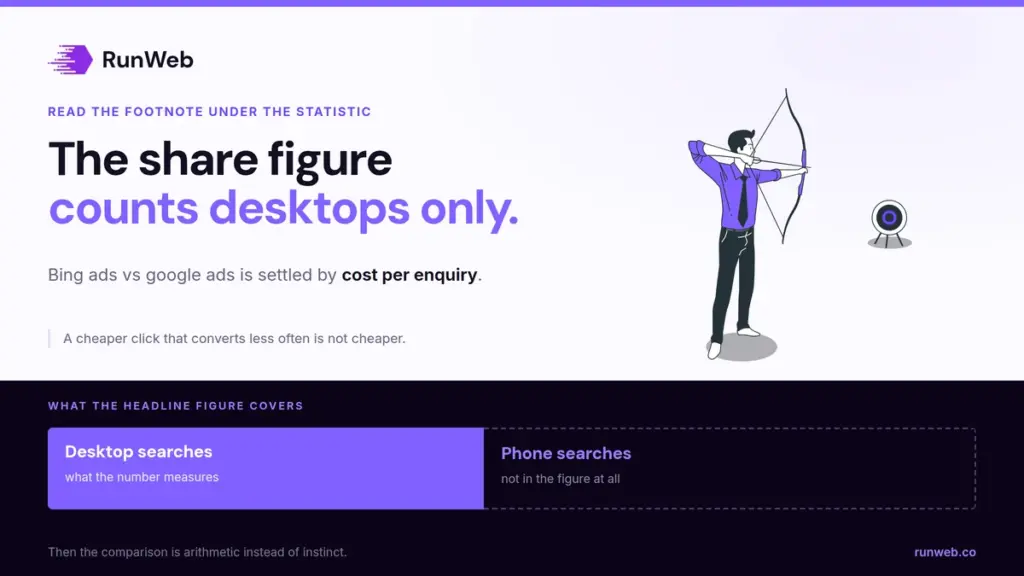
- The market-share figure people quote is measured on desktop traffic only, so it says nothing about the phone searches most local businesses live on
- Work out what you can pay for an enquiry first, because a cheaper click that converts less often is not cheaper
- Both platforms price clicks by auction and reward the same things, so your landing page matters on either one
- Testing a second platform costs attention rather than build time, since campaigns import across in a few clicks
The cheaper click is real, and it is not what decides this.
Microsoft’s clicks often cost less than Google’s, and its audience is smaller. Both are true at once, which is why the comparison usually ends in a shrug and a decision made on instinct.
What settles it is your own cost per enquiry, measured against what an enquiry is worth to you. A cheaper click that converts less often is not cheaper at all.
So here is what that famous share figure actually measures, and the arithmetic sitting underneath the choice.
The share number is desktop only
Every argument for the second search engine opens with a share statistic, and the statistic is real. Reading its footnote changes what it means.
Those figures come straight from the source. Microsoft’s own search network data reports the United States figures directly, and the citation underneath them is the part that matters.
- 10.1 billion monthly PC searches in the United States.
- 186 million unique PC users.
- 39.1% PC market share.
The footnote reads Comscore qSearch, United States, desktop traffic only. So the impressive figure describes people sitting at computers, and it is silent on phones.
Why that matters for a local business
That distinction decides a lot for a local business. Somebody looking for an emergency plumber is almost never at a desk. When most of your demand arrives on a phone, a desktop share figure is describing a slice of the market you may barely sell into.
Which does not make the platform useless, since plenty of business-hours searching does happen on work computers. It makes the headline number the wrong thing to decide on, and the same trap shows up whenever trades marketing gets argued from national averages.
Cheaper clicks are not the decision
That share figure sets the size of the pond. Click price sets what it costs to fish in it, and neither one tells you whether you will catch anything.
That figure is cost per enquiry, and it is the one your bank account recognises. Google’s documentation on target CPA bidding is built on the same premise, since it asks you to set a desired average cost per conversion and then bids against the likelihood of converting.
- Work out what a customer is worth: Average job value multiplied by how often a typical customer returns, taken from your records.
- Find your close rate: How many enquiries become paying work, measured over the last full quarter.
- Set your ceiling: Customer value multiplied by close rate, which is the most an enquiry can cost before it stops being worth having.
- Compare the platforms on that ceiling: Cost per enquiry on each, not cost per click, and only after enough conversions to mean something.
Which is where the cheaper click usually stops being an argument. A platform with clicks at half the price and a third of the conversion rate is the more expensive option, and only the enquiry figure reveals it.
And none of it works if enquiries are not being counted properly, which is the setup problem covered in counting the result.
What decides your cost per enquiry
Those numbers are not fixed properties of a platform. Both run auctions, and both reward broadly the same things, which means a good chunk of your cost per enquiry is under your control.
Ahrefs’ guide to how PPC works describes the auction as weighing your bid, your ad quality through Quality Score, and the expected impact of your ad formats. Quality Score itself takes in expected click-through rate, ad relevance and landing page experience.
One of the three inputs is not in the ad account at all, since landing page experience lives on your website.
Which means a business getting poor results on one platform often gets poor results on both, for a reason neither platform caused. Testing a second auction does not fix a page that nobody enquires through, and the landing page is usually the cheaper thing to change first.
What a second platform really costs
Those inputs cost nothing to fix. Setup effort is the objection most owners raise instead, and it is the weakest one. Microsoft’s import tools bring campaigns across from Google Ads in a few clicks, with the option to import everything or pick specific campaigns and adjust bids and budgets on the way in.
- Build time: Close to nothing, since the campaigns already exist and the import carries the structure across.
- Budget: Real, and it is split off your existing spend rather than added to it, which makes the first month slower on both.
- Attention: The genuine cost, because two accounts need two sets of negatives, two sets of search terms read and two reports understood.
- Data volume: The hidden one, as splitting a small budget across two auctions can leave neither with enough conversions to optimise against.
That last row is the reason small accounts often should not split. Automated bidding needs conversions to learn from, and halving an already thin stream of them slows the learning on the platform that was working.
When running both makes sense
So four conditions separate a sensible test from an expensive distraction, and they are about your account more than the platforms.
| Condition | Test it makes sense | Test it does not |
|---|---|---|
| Conversion volume | Enough enquiries monthly that a split still leaves each side measurable | A handful of enquiries that cannot survive being halved |
| Where your buyers search | Business-hours demand, often from desktops | Emergency or on-the-move demand, almost entirely phones |
| Google account maturity | Already optimised, with cheap wins exhausted | Still has obvious waste in search terms and negatives |
| Who watches it | Somebody has the time for two accounts | The first account is already reviewed once a quarter |
Those middle two rows get the attention, and row three is the one most often skipped. Money moved to a second platform before the first one is tidy tends to buy the same mistakes in a new place, and the same logic applies when the alternative is boosting against campaigns on social or a directory instead.
How to structure the test if you run it
Keep the majority of the budget where the enquiries already arrive, and give the second account a minority share it can still learn from. A split that leaves both accounts starved teaches you nothing about either.
Run it long enough to gather conversions at your actual volume, and compare the two on cost per enquiry against the ceiling from earlier. Cost per click, impression share and the size of the audience are context, and none of the three answers the question you started with.
Write down what would make you stop before you begin, since a test with no exit condition quietly becomes a permanent second budget line that nobody reviews.
For businesses still deciding between paid and organic instead of between two paid platforms, splitting a small budget covers that choice, and local service ads covers the other Google product trades businesses get pitched.
To be straight about it, we run Google and Meta campaigns and we do not manage Microsoft ones, so this post is not a pitch for a second account. If the arithmetic above lands on tightening the Google side first, that part is our ads work.
Frequently Asked Questions
Are Microsoft clicks always cheaper than Google’s?
Not reliably, and it varies by industry and by keyword. Treat any blanket percentage you read as a starting hypothesis to test on your own account, never a figure to plan around.
Can I run the same ad copy on both?
You can, and the import is built to let you, though copy tuned for one audience does not automatically suit another. Watch the search terms on the new account before assuming the targeting travelled with the text.
How long should a test run before I judge it?
Long enough to collect enough conversions for the comparison to mean something, which on a small budget means months and not weeks. Calling it after a fortnight measures noise.
Does the smaller audience mean less competition?
Often, and that is the honest case for the platform. Fewer bidders can mean a lower price for the same position, which only helps if the people searching there are the people you sell to.
Should I split the budget evenly to be fair?
Fairness is not the goal and an even split is usually the wrong shape. Keep the majority where the enquiries already come from, and size the test by what you can afford to learn from.