🎯 Key Takeaway
- Working out what happens when a domain expires matters because the name stays recoverable for a while, then stops
- Your registrar has to warn you twice before the date and once after it
- The site is switched off during the window when you can still renew, by policy rather than by accident
- After deletion there is a 30-day redemption period, and it carries a fee your registrar already publishes
- Email goes down with the domain, which is usually how the problem gets noticed
A domain is rented, never bought.
Most owners learn that on the day it stops working. The renewal date slides past and the site goes down, and what turns up next is advice written almost entirely by the people selling the expensive way back.
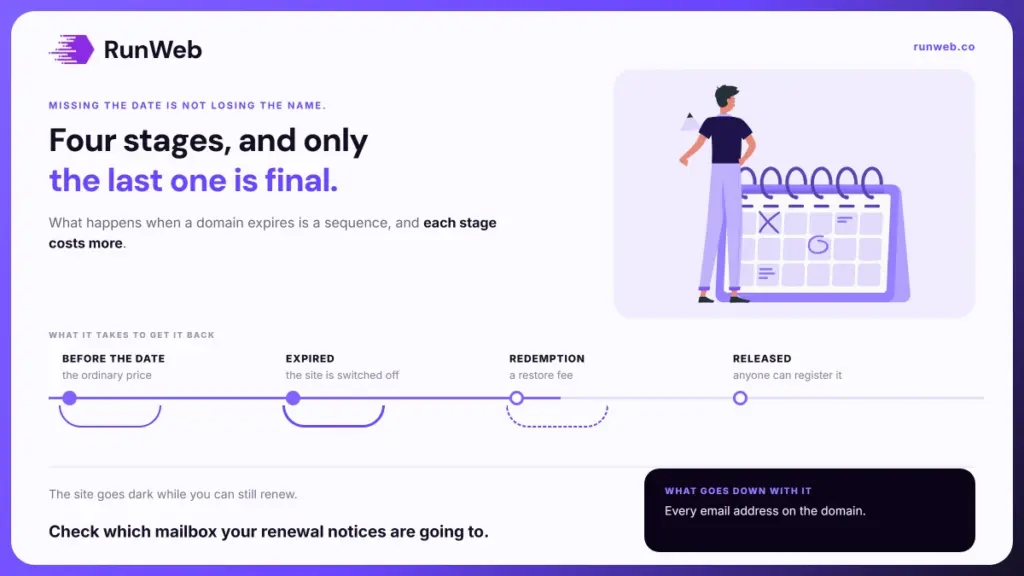
But missing the date is not the same as losing the name. Between the renewal date and the day a stranger can register it there is a sequence of stages, and each one costs more than the last to reverse.
So the useful thing to know is which stage you are standing in.
The date is not the deadline
That sequence exists because of how registration works in the first place. HubSpot puts it plainly in its guide to what a domain is, noting that although you can purchase one, it isn’t permanent like property, and once you stop paying somebody else can have it.
What that skips is the middle. The clock runs through four stages that most owners have never seen written down, because the only people who explain them are selling the expensive stage.
Each stage has a different answer to one question, which is what it costs to get the name back.
| Stage | Is the site up | What it takes to recover |
|---|---|---|
| Before the date | Yes | The ordinary renewal price |
| Expired, not yet deleted | No, switched off | Renewal, sometimes at a late price |
| Deleted, in redemption | No | A restore fee, usually many times the renewal |
| Released | No | Nothing you control. Anyone can register it |
Rows two and three are where the confusion lives. Both look identical from outside, since the site is down either way, and they are separated by a decision your registrar makes rather than by anything you did.
What your registrar has to tell you
Before any of that happens you are owed notice, and the amount of notice is not up to the company you bought from. The Expired Registration Recovery Policy sets a floor that every accredited registrar has to meet.
- Two warnings before the date: One roughly a month before expiry and one roughly a week before, sent to the registered holder.
- One more after it: If the name is neither renewed nor deleted within five days of expiring, at least one further notice has to go out carrying renewal instructions.
- By a method that reaches you passively: The policy requires a channel like email, so a notice buried in a control panel you never open doesn’t satisfy it.
- Fees published in advance: Renewal, late renewal and redemption prices all have to be shown on the registrar’s website and linked from its agreements.
Point one is where most losses actually begin. Those notices go to whichever address is on the registration, and when a domain was set up years ago by a developer or a former employee, the warnings are arriving somewhere nobody reads.
The commonest version of this story is not an owner ignoring three emails. It is three emails arriving at an address that stopped being monitored two jobs ago.
The day the site goes dark
Once the date passes, the site coming down is deliberate. Under the same policy the registrar has to interrupt the name’s DNS for at least the last eight consecutive days that renewal is still possible, so the outage is a feature of the system rather than a fault in it.
The reasoning is sound, even though it stings. An expired name that kept working would give owners no reason to act until it disappeared entirely, and by then the cheap window has closed.
- The site stops loading: Visitors get an error or a parked page instead of your homepage.
- The parked page has to be honest: Where the registrar puts up a holding page while renewal is still open, it must say clearly that the registration has expired and give instructions to renew.
- You can still renew throughout: The registrant keeps the right to renew for the whole interruption period.
- Restoration is prompt: On renewal the registrar has to put the DNS back immediately, or as soon as is commercially reasonable.
So an expired domain that has gone quiet is usually still an easy fix. Because the site being down is the loudest possible signal, plenty of owners catch it here and pay nothing beyond the ordinary renewal.
Deletion, and the thirty days after
Past that window, the registrar may delete the registration, and it can do so at any time after expiry. Deletion is the moment the price changes.
What follows is a 30-day Redemption Grace Period, which every general top-level registry has to offer. During it the deleted registration can be restored at the registrant’s request, but only by the registrar that deleted it, so shopping around is not available to you here.
Three things are true at once inside those thirty days. The name is still recoverable, the DNS stays disabled so nothing works, and transfers to another registrar are blocked.
The fee nobody looks up until they need it
Restore pricing sits far above renewal pricing, and it varies widely between registrars. Because the policy obliges every registrar to publish that figure at the point of sale, you can read yours this afternoon rather than discovering it during a bad week.
When somebody else can take it
After redemption ends the name is released, and at that point it stops being a recovery problem. Anyone can register it, and on a name with any history somebody usually does.
Ahrefs makes the point inside its migration guide, advising owners to keep watching an old domain’s renewal specifically so a competitor cannot pick it up. The advice is aimed at a domain you meant to retire, and it applies with more force to one you didn’t.
- Your links now point at a stranger: Every directory listing, invoice, van and business card sends people to whoever owns the name.
- Your email address belongs to them: Mail sent to your old address arrives at their server, including anything a client replies to.
- Search equity transfers with it: Years of accumulated authority now sits under somebody else’s content.
- Buying it back is a negotiation: There is no policy price at this stage, only whatever the new holder wants.
Checking where you stand takes a minute. ICANN Lookup is the official registration data service, and it will show your name’s expiry date and current status without you logging in anywhere.
What else stops working
By now the website has had all the attention, and it is rarely the expensive part. The domain is the address for everything pointed at it, so the outage spreads further than the pages.
- Email stops first and hurts most: Every address at your domain dies with it, and senders get bounces rather than a warning you can see.
- Password resets become impossible: Any account tied to that email address, including your hosting and your registrar, now sends its reset link into a void.
- Anything authenticating on the domain breaks: Booking tools, quoting software and payment notifications that send from your address stop being delivered.
- Your certificate lapses alongside it: When the name comes back the encryption often needs re-issuing, which is the second fault in a not secure warning.
The version of this that never happens
Two habits remove the whole sequence. Put the renewal on a card that doesn’t expire before the domain does, and make sure the registration’s contact address is one a person still reads, which is the same discipline behind choosing a name you keep.
Both belong to whoever holds the account, and that is the awkward part when the account is not yours. If you would rather the renewals, the hosting and the certificate all sat in one place with somebody watching the dates, that is what our websites and hosting service covers. What a plan like that includes is broken out in care plan costs, and the build side sits in what a website costs.
Frequently Asked Questions
How long do I actually have before it is gone for good?
Longer than the panic suggests, though the exact figure is your registrar’s choice. Expiry, then deletion at a time they pick, then a fixed 30 days of redemption, and only after that is it public again.
Can I move the domain somewhere better while it is expired?
Transfers are blocked during redemption, so the registrar that deleted it is the only one who can bring it back. Move it afterwards, once the name is safely renewed.
Will my website come back exactly as it was?
Usually, because the files sit with your host and are untouched by the domain lapsing. The pages return when the name resolves again, although encryption sometimes needs reissuing.
Why did I never get a warning email?
Almost always because the registration carries an old address. Check which mailbox is listed against the name, then change it to one somebody currently reads.
Is auto-renew enough on its own?
Only while the card behind it works. An expired card silently turns auto-renew into no renewal, and that is the single most common way a live domain lapses.