🎯 Key Takeaway
- Google ads management cost is the fee paid to whoever runs the account, and it sits on top of the money that goes to Google
- Agencies charge a flat fee, a percentage of your ad spend, or a blend of the two, and each one hides something different
- The fee and the spend are not independent, because account quality is part of what decides your cost per click
- Hold the admin access yourself and let the agency work at standard level, so the account stays yours
- Work out what an enquiry is worth to you first, since every other number in the quote is meaningless without it
The management fee is the smaller number, and it is the one that gets negotiated hardest.
Ad spend goes to Google. The fee goes to whoever runs the account, and the two are quoted together often enough that plenty of owners never separate them.
Separating them is the first useful thing to do, because the second is noticing they are not independent. A well-run account changes what each click costs you.
So here is what the fee covers, how it gets charged, and the arithmetic that says whether it is worth paying.
What the fee sits on top of
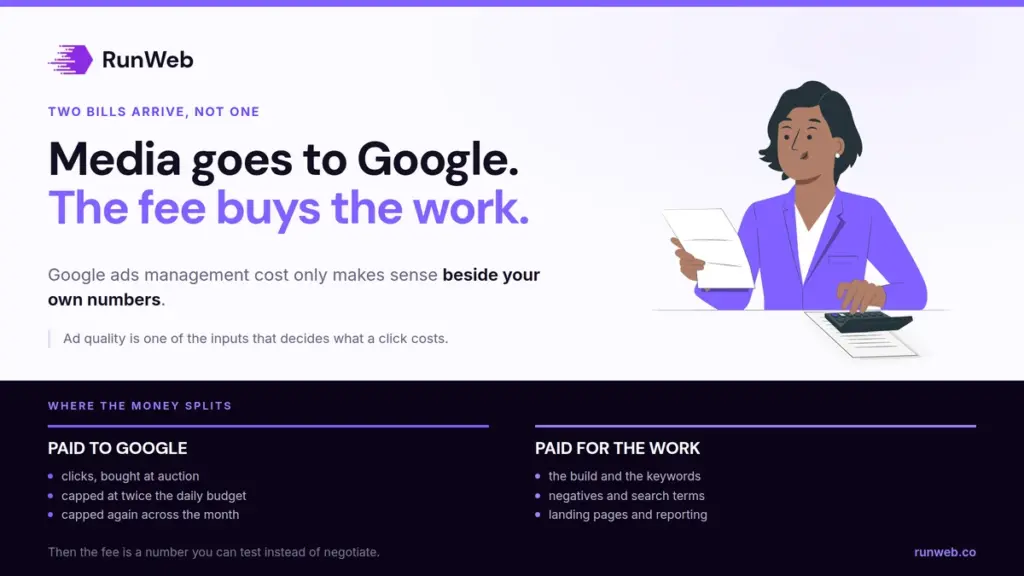
Two separate bills arrive, and conflating them is how a budget conversation goes wrong in the first five minutes. One is media, paid to Google. The other is labour, paid to a person.
The media half behaves predictably once you know the rules. Google’s documentation on average daily budgets describes the figure you set as roughly what you are comfortable spending per day across a month, and caps what can actually be charged.
- You will never pay more than twice your average daily budget on any particular day, for most campaigns.
- You will never pay more than 30.4 times that budget in any particular month, for most campaigns.
Which means your ad spend has a ceiling you control directly. The labour half has no such ceiling, since it is whatever you agreed to, and that is the number this post is about.
The three ways agencies charge
Those structures come down to three, and Semrush’s analysis of Google Ads costs sets them out plainly: some charge a flat fee, some charge a percentage of ad spend, and some offer a hybrid. Its worked example puts a 15% fee on a $1,000 budget at $150.
| Structure | What it rewards | What to watch |
|---|---|---|
| Flat monthly fee | Predictability for you, efficiency for them | Whether the hours quietly shrink once the account is stable |
| Percentage of ad spend | Scaling with the account | The incentive points at spending more, not at spending better |
| Hybrid | A floor for small accounts, upside on large ones | Two moving parts, so the run rate is harder to forecast |
| Setup or onboarding charge | The build, which is real work | Whether it recurs when campaigns get rebuilt later |
Row two is where most of the friction lives. A percentage arrangement pays more when your budget grows, so the quarterly recommendation to increase spend arrives from someone who benefits from it, and that conflict is structural rather than dishonest.
Each of the three is defensible. What matters is knowing which incentive you’ve bought, and a similar problem shows up when you compare website packages and the tiers differ in ways the price list does not explain.
Why the fee and the spend move together
Which is why treating the fee as pure overhead misses the mechanism. Ahrefs’ guide to how PPC works describes the auction as weighing your bid, your ad quality through Quality Score, and the expected impact of your ad formats.
That score takes in expected click-through rate, ad relevance and landing page experience. Ahrefs draws the conclusion directly: the more relevant and well written your ads are, the less you pay.
Management is not only a cost sitting beside the media budget, since the work it buys is one of the inputs that decides what the media budget buys.
The part that happens off the ad
Landing page experience is a third of that quality signal, and it lives on your website instead of inside the ad account. An agency that never mentions your landing pages is managing two of the three inputs.
Which is worth checking before you blame the campaigns, because the landing page often explains more of the result than the bidding does.
The arithmetic on your own account
Those inputs are why benchmarks are a starting point and nothing more. Semrush puts the average cost per click across industries at $2.69 on Search and $0.63 on Display, which tells you the shape of the market and nothing about your business.
So four numbers of your own settle it, and you can get all four in an afternoon.
- What a customer is worth: Average job value, multiplied by how many times a typical customer comes back.
- How many enquiries become customers: Your close rate, taken from the last full quarter and not from memory.
- What you can pay for an enquiry: Customer value multiplied by close rate, which is the ceiling everything else has to fit under.
- What the total costs: Media plus fee, divided by enquiries, compared against the ceiling from step three.
Step four is the whole test. If media plus fee per enquiry sits under what an enquiry is worth, the arrangement works at your current volume, and if it doesn’t, no amount of reporting changes that.
The figures only mean something once enquiries are actually being counted, which is the setup problem covered in checking the work. An account measuring clicks instead of calls can’t run this test at all.
What to hold the arrangement to
With the fee structure decided, four conditions are worth writing down before the first invoice. Each one has cost somebody something on the day it was missing.
- The account is in your name: Google’s access levels run from email-only through billing, read-only and standard to admin, and only admin can add or remove product links.
- You keep admin, they get standard: Standard access edits campaigns and runs reports, which is everything the work needs, and it leaves the account yours if the relationship ends.
- The conversion is defined in writing: A submitted form or a call over a set length, agreed before anyone reports on it, so the definition cannot move to flatter a month.
- Spend and fee appear on separate lines: One invoice showing both, because a single blended figure makes the test in the previous section impossible to run.
That access line sounds procedural, and it’s the one that bites hardest. An account you can’t log into is an account you can’t take with you, and rebuilding the history costs more than the fee ever did.
When paying for management stops making sense
Those conditions assume the arrangement is worth having at all. Management earns its keep through waste removed and quality improved, and both scale with how much is being spent, so below a certain budget the fee eats the account.
- The fee is a large share of total outlay: When labour rivals media, most of your money is buying oversight of a very small campaign.
- There is nothing left to optimise: A handful of keywords in one town reaches its ceiling quickly, and further work is maintenance.
- The enquiries are not being counted: Without conversion data nobody is optimising anything, whatever the report says.
- Another channel is cheaper for you: Worth testing before you scale spend, not after.
Where that last point applies, the comparison is covered in splitting a small budget, with the trade-focused version in local service ads and the social equivalent in boosting against campaigns. For businesses weighing the directory route, Yelp against Google covers that one.
We don’t publish a rate card, because the right fee depends on spend, account size and how much of the work is build rather than upkeep. When you would rather have the campaigns, the landing pages and the enquiry tracking handled by one team on a rolling monthly agreement, that is how our ads work is set up.
Frequently Asked Questions
Is a percentage fee ever better than a flat one?
It suits accounts that actually grow, since the work does increase with scale. On a budget that stays flat all year, a percentage buys you the same service as a flat fee with an incentive attached.
Should the setup charge be refundable if it does not work?
Build work is real work and gets paid for, so a refund is an unusual ask. A fairer condition is that the account and its history stay yours, which makes the build reusable by someone else.
How long before I can judge whether the fee is worth it?
Long enough for conversion data to accumulate at your volume, which on a small budget can take a couple of months. Judging it on clicks in week two tells you about traffic and nothing about money.
Can I just run the account myself?
Plenty of owners do, and the ceiling is usually time instead of ability. The honest version of the question is what an hour of yours is worth against what the fee would be.
My agency will not give me admin access. Is that normal?
It is common and it is not in your interest. A working compromise is that the account sits under your login with the agency at standard level, which lets them do everything the campaigns need.