🎯 Key Takeaway
- Asking how much do facebook ads cost has no single answer, because Meta runs an auction rather than a price list
- Three things decide what you pay, and two of them are about your ad rather than your money
- The budget you set controls spending, not what each result costs you
- Published benchmarks are averages across whole countries, so they describe a market and not your account
- A small service area is the constraint that bites local advertisers first, and it is the one nobody warns you about
There is a number people want here, and no honest way to give it to them.
Every page answering this question hands over an average. The averages are real, and they are built from tens of thousands of accounts across entire countries, which is exactly why none of them describes yours.
Meta has no price list. It runs an auction, and an auction charges whatever the competition and your own relevance decide on the day.
So the useful answer is a mechanism rather than a figure, and the mechanism turns out to be short.
Why the question has no answer as asked
Both halves of the question are moving. What you are buying changes with the objective you pick, and what it costs changes with who else wants the same attention that afternoon.
- You are not always buying the same unit: Some objectives charge for a click, others charge per thousand times the ad is shown.
- Your competition is not fixed: The other advertisers chasing your audience change by hour, by season and by whatever is happening in the news.
- Your audience has a size: A small one runs out of fresh people quickly, which pushes costs up without anything in your account changing.
- Your ad is an input, not a constant: A better ad pays less for the same placement, which is the part most cost guides skip.
HubSpot notes one of those directly in its material on lead ads, pointing out that some objectives let you choose between paying per click and paying per thousand impressions, while the lead generation goal is set to the impression basis.
So two advertisers can spend identical money and buy quite different things. The unit is not fixed, which makes a shared benchmark shaky before anything else is considered.
What the auction actually weighs
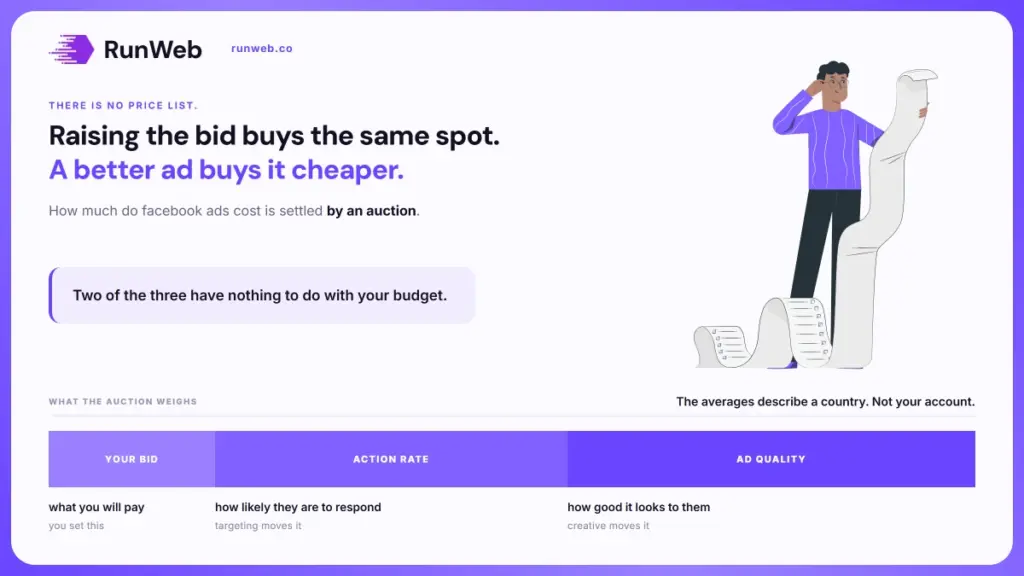
Those moving parts resolve into one calculation, and it is simpler than the mystery around it suggests. Semrush sets it out in its breakdown of Facebook ad costs, describing a formula that balances the advertiser’s bid, the estimated action rates and the ad quality.
| The input | What it means | How fast you can move it |
|---|---|---|
| Your bid | What you are willing to pay for the outcome | Instantly, and it is the least interesting lever |
| Estimated action rate | How likely Meta thinks this person is to do the thing | Slowly, through targeting and offer |
| Ad quality | How good the ad looks to the person seeing it | Quickly, by replacing the creative |
Two of the three have nothing to do with how much you are prepared to spend. Bidding is the small lever. The other two are about fit, and Semrush draws the conclusion plainly: ads with more relevance to the user cost less and are favoured in the auction.
Raising your bid buys the same placement at a higher price. Improving the ad buys it at a lower one, which is why cost questions so often turn out to be creative questions wearing a budget disguise.
And the same page lists what feeds into those inputs in practice: where the ad appears, the total value the system assigns it, your bidding strategy, the schedule you run it on, and the audience you chose.
The budget is not the cost
That formula explains the confusion underneath most of these searches. Budget and cost are different words. People ask what ads cost when the number they can actually set is the budget, and those are two separate questions.
HubSpot describes the budget step as choosing the average you want to spend per day and how long the ad should run. Nothing there sets what a click or a lead costs.
- Budget is a tap: It controls how fast money leaves, and you set it directly.
- Cost per result is an outcome: It falls out of the auction, and you influence it rather than set it.
- The two move independently: Doubling the budget can leave cost per result flat, raise it, or occasionally lower it.
- Only one of them is knowable in advance: Which is why every per-day answer to this question is really answering a different one.
So the per-day, per-week and per-month phrasings people search are budgeting questions in disguise. The honest reply is that you can spend almost any amount, and what matters is whether the results justify it at that level.
Why the benchmarks do not fit you
Those outcomes vary enough that published averages deserve a closer look than they usually get. The good ones are honest about what they measure, and what they measure is not your business.
Statista’s comparison of cost per click is a fair example. It was built with Metricool from 26,223 advertising accounts and 211,929 ad campaigns, and it reports an average for each country, with the United Kingdom, Germany and the United States at the top.
What a number like that can and cannot tell you
That sample is large. It is informative about exactly one thing, which is that costs differ by market, so an advertiser in one country should not expect another country’s figures to transfer.
- It is a country, not a niche: Emergency plumbing and phone cases sit inside the same national average.
- It is a snapshot, not a trend: Any benchmark describes the window it was measured in, and auctions do not hold still.
- It is an average, not a prediction: Half of everyone measured paid more than it, and nothing says which half you are in.
- The useful figures are usually behind a paywall: The headline gets quoted everywhere and the methodology rarely travels with it.
Which is the same trap the click-price argument runs into on search. A cheaper click that converts less often is not cheaper, a point covered properly in the second search engine.
The constraint local advertisers hit first
That averaging problem hides the thing that actually drives cost for a small local business, and it is not competition or creative. It is the size of the audience you are allowed to show ads to.
Audience is one of the factors Semrush lists, and for a national advertiser it barely binds. For a business serving one town it binds immediately, because there are only so many people inside the area who match the targeting.
Once the campaign has shown the ad to all of them, it starts again from the top. The pool runs dry. The same people see it more often, respond less, and the estimated action rate that helps decide your price starts to fall.
And that mechanism explains a pattern owners find baffling. A campaign works beautifully for two weeks and then quietly gets more expensive, with nothing changed in the account.
- Widen the area before widening the budget: More budget into a saturated audience buys repetition.
- Rotate the creative on a schedule: New material resets the response rate without changing anything else.
- Watch how often the same person sees it: Rising frequency is the early warning, well before cost per result moves.
Which input to move
So the practical answer to the cost question is an order of operations, and the bid comes last rather than first.
- Fix the destination: A click that lands somewhere confusing wastes every other improvement, and the choice of page is set out in where to send a click.
- Replace the creative: The fastest of the three inputs to move, and the one with the most room in most accounts.
- Check the audience size: Widen the area or loosen the targeting before assuming the ad is the problem.
- Then look at the bid: Once the other two are working, paying more buys more. Before that, it buys more of the same result.
None of that requires knowing what anybody else pays. And it cannot be judged at all until results are being counted properly, which is the measurement problem set out in checking the work.
Where the question is whether to use the boost button or build the campaign properly, that comparison sits in boosting against campaigns. What an agency charges to run any of it is in management fees, and how to divide one budget between channels is in splitting a small budget.
When you would rather have the campaigns, the creative and the page they land on handled by one team, that is how our ads work is set up.
Frequently Asked Questions
What is the smallest budget worth running?
Enough that the campaign gets a reasonable number of results a week, since a handful gives you nothing to learn from. Running a small amount for a full month beats a large amount for four days.
Do I pay more because my industry is competitive?
Competition for the same attention does push prices up, though it is one input among several. A well-targeted ad in a busy category often costs less than a vague one in a quiet category.
Why did my results get more expensive without me changing anything?
Usually audience saturation, especially on a small service area. Check how often the same people are seeing the ad before you touch the budget.
Is Instagram cheaper than Facebook?
Placement is one of the factors that moves price, so the two can differ. Letting the system choose placements usually beats guessing, unless the creative only works in one format.
Should I set a bid cap?
Only once you know what a result is worth to you, otherwise the cap is a guess that quietly limits delivery. Most accounts do better leaving it off until there is enough data.