🎯 Key Takeaway
- Knowing how to choose a domain name matters because the name outlives the design, the copy and the platform you build on
- The two names that expire are the ones carrying a town you will leave and a service you will add to
- Keywords in the name do not lift rankings, so an awkward name buys nothing back
- Your extension is a signal about where you trade, not a score
- Changing later costs traffic and takes months of redirects, which is the real reason to get it right once
A domain name is the only part of your website that survives every rebuild.
Everything else gets replaced eventually. The design ages out, the copy gets rewritten by whoever comes next, and the platform underneath gets swapped when it stops earning its keep.
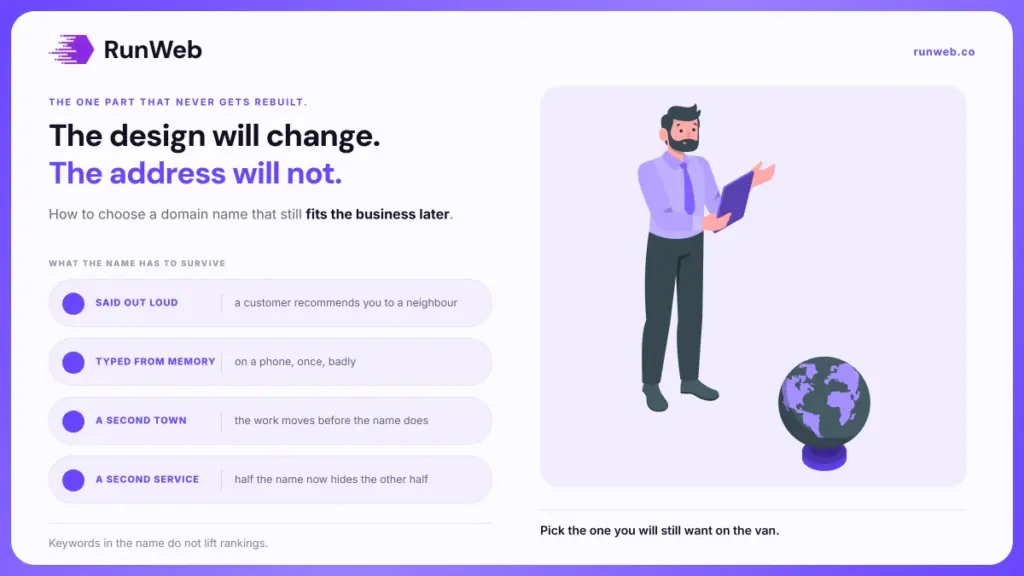
The name stays. It goes on the van, on the invoices, on the quote emails and in the mouths of customers reading it back to you over the phone.
So it deserves more than the ten minutes it usually gets between picking a logo colour and paying for the first year of hosting.
What the name is actually doing
Most advice on this treats the name as a marketing asset, and it is really doing four jobs at once. Only one of them happens on a search results page.
- It gets typed: Someone heard it once and is keying it in from memory, usually on a phone, usually badly.
- It gets said out loud: A customer recommends you to a neighbour, and every ambiguous letter in the name costs you that referral.
- It gets read in a list: Your name sits beside four competitors in search results, and it either looks like a business or it looks like a placeholder.
- It anchors everything else: Email addresses, tracking, certificates and every link anyone has ever built to you all hang off it.
That last job gets forgotten. On day one there is nothing hanging off the name yet, and three years in there is quite a lot of it.
So the test worth applying is not whether the name sounds clever now. The question is whether it still works when the business it describes has changed shape.
Should it match your business name
That question comes up more than any other, and the answer is yes in almost every case worth arguing about.
People search for you by name once they have heard of you. So a mismatch costs you twice. When the trading name and the web address disagree, you have asked every customer to remember two things instead of one, and the second is the one they get wrong.
A mismatch between the name on your van and the name in the address bar is a cost you pay on every single referral, forever, in exchange for nothing.
Where it gets awkward is when the exact match is already taken, which for any common trading name it usually is. The workable answers are narrow and none of them involve a creative spelling.
- Add the trade: Your name plus plumbing, roofing or electrical reads naturally and is still obviously you.
- Add the region, carefully: Only if the region is permanent, which the next section is about.
- Shorten it: If customers already abbreviate your business name in conversation, that abbreviation is a real candidate.
- Change the extension: The same words on a different ending, which costs less than most people assume.
Deliberate misspellings belong nowhere on that list. Every one of them converts a spoken recommendation into a spelling lesson.
The two names that expire
Those options come with one trap each, and both traps have the same shape. The name is accurate the day you buy it and stops being accurate later, at exactly the point where changing it is most expensive.
| The name | Why it looked right | What breaks it |
|---|---|---|
| A town or suburb in the name | Local relevance, and it was available | You take work two towns over and the name argues against you |
| A single service in the name | It described the whole business | You add a second service and half your name now hides it |
| A founder surname plus partner | Both names were on the paperwork | One partner leaves and the address is a monthly reminder |
| A trend word or spelling | It felt current | It dates the business to a year nobody wants to advertise |
The town one deserves a warning of its own, because it is the commonest mistake in the trades and the least obvious. A service business almost always grows outward geographically before it grows in any other direction.
And the fix is not to avoid geography altogether. You can carry the area in your page content and your profile without welding it to the address, which is how the service area problem is normally handled anyway.
What the extension changes
Those examples are about the words. The ending has a smaller effect than the debate around it suggests, and the effect it does have is about geography rather than quality.
Ahrefs sets out the split plainly in its reference on top-level domains. Generic endings are open to anyone, country endings are tied to a place, and it states that country endings “tend to rank better in local search results than generic top-level domains”.
What that means for a local business
If you trade in one country and have no intention of leaving it, a country ending is a real signal and costs you nothing. If you sell anything that crosses a border, the generic ending is the safer default.
Two smaller points are worth knowing before you commit.
- Some country endings are not treated as local: Ahrefs notes that Google treats certain ones as generic, because owners and users read them as generic.
- Availability is a legitimate reason: An exact match on a less common ending often beats an approximate match on the obvious one.
Why keywords in the name are not the lever
Those endings raise the other half of the myth, which is that stuffing your trade and your town into the address does the ranking work for you. It does not, and the people selling ranking software say so.
Ahrefs is direct about it in its guide to SEO-friendly URLs: “just because keywords are in a domain name doesn’t mean that it’ll automatically rank for those keywords.” The same page adds that repeating keywords in URLs makes them look spammy.
So the exact-match name buys you a small familiarity effect at most, and it costs you the four jobs in the first section. It is harder to say, harder to type and it tells a customer nothing about who you are.
Where the keyword work does pay
That work moves one level down, into the addresses of the individual pages. Google’s own URL guidance asks for readable words rather than long ID numbers, and for hyphens instead of underscores between them, which is a page-level decision you keep making long after the name is settled.
And those page addresses are cheap to change while a name is not. How many of the pages you need is a separate question with its own answer.
The cost of changing your mind
All of this only matters because the undo button is expensive. A name change is a site move, and a site move is a project with a tail measured in months.
Google’s documentation on site moves is unusually blunt about the timeline. It says to “keep the redirects for as long as possible, generally at least 1 year”, to expect temporary fluctuation in rankings during the move, and that a small to medium site takes a few weeks for most pages to move across.
Semrush’s account of changing a domain adds the part that surprises owners most. Links other sites built to your old address do not follow you automatically, and it warns that organic traffic “will almost certainly drop” before it rebounds.
So a move splits into three piles, and only one of them travels for free.
- Comes with you: Your content, your structure and anything you control directly.
- Has to be rebuilt: Certificates, email routing, tracking setup and every profile that names the old address.
- May not follow at all: The links other people built, which is the pile you cannot fix from your side.
Neither warning is a reason to never move. Both are reasons to treat the first choice as a decision with a price attached, and the mechanics of doing it safely sit in the redesign checklist.
Settling it in an afternoon
By now the shortlist writes itself, and the process below takes about two hours if you stop looking for a perfect answer.
- Write five candidates: Start from your trading name, then apply the four workable variations from earlier.
- Say each one down the phone: Read it to someone who has never seen it written and ask them to type it. Anything they get wrong is out.
- Run the ten-year test: Add a second service and a second town to the business in your head. Anything that now reads as a lie is out.
- Check both endings: Look at the generic and the country version of whatever survives, and price them both.
- Buy it in your own name: Register it yourself, on your own card, with your own email on the account.
Step five costs people real money later. A name registered under an agency’s account is a name you are renting, and the ownership side of that is set out in what a small business site costs.
Once the name is settled, the rest of the budget becomes legible. The recurring side of it sits in ongoing upkeep and the build side in the package tiers, neither of which changes because of which name you picked.
When you would rather hand the whole sequence to someone who does it weekly, registration in your name included, that is how we set up every build on our websites service.
Frequently Asked Questions
Can I buy several endings and point them all at one site?
Plenty of owners do, mostly to stop somebody else taking them. Pick one as the real address, redirect the rest to it, and never let two of them serve the same pages independently.
How long should I register it for?
Several years at once if the budget allows, because an expired registration is the fastest way to lose an address you have spent years promoting. Turn auto-renewal on and keep the billing card current.
Does a hyphen in the address hurt me?
Between words inside a page path it is the recommended separator. In the name itself it costs you every time somebody says the address out loud, so avoid it there.
What if the name I want is parked by a squatter?
Ask the price before assuming it is out of reach, since many parked names sell for less than a month of advertising. If the number is silly, take a variation and move on the same day.
Is a longer, more descriptive address ever the right call?
For a business that gets found by word of mouth, almost never. The exception is a second address used only in print or on a vehicle, pointed at the real one.